

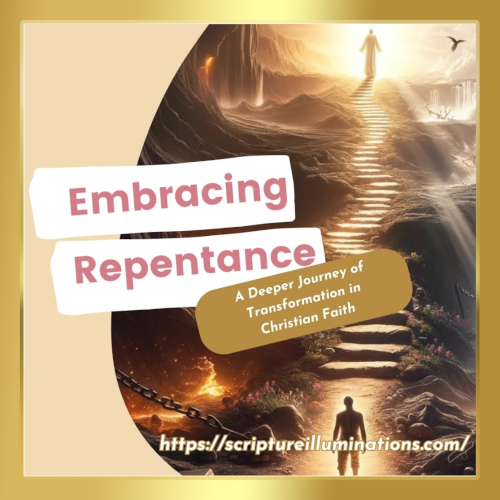
Most Christians have a complicated relationship with the word “repentance”. They know it matters. They have heard it preached, and they understand in principle that it is central to the Christian life. And yet, for many believers, the practice of repentance tends to produce something closer to guilt than to freedom, something that leaves them circling their failures rather than moving away from them. They confess, they resolve, they fall again, they confess once more, and the cycle continues without the transformation they were promised.
Some of this is simply the difficulty of change, which is real. But some of it reflects a misunderstanding of what repentance actually is. If repentance is primarily about feeling sufficiently sorry, then it degenerates into a performance of remorse that measures itself by the intensity of the guilt experienced. If it is primarily about making promises to do better, it becomes an increasingly demoralising cycle of failure. If it is understood as the mechanism by which forgiveness is earned, it becomes a burden no one can carry.
Scripture’s account of repentance is more interesting and more liberating than any of these framings. It is a word about direction more than feeling, about movement more than emotion, about who you are returning to rather than merely what you are leaving behind. Understanding this properly makes repentance not something to dread but something to pursue, because it is the path back to the only relationship that can satisfy the deepest longings of a human life.
What the Words Actually Mean
The place to begin is with the biblical vocabulary itself, because the actual words used for repentance in Scripture carry more weight than is often recognised.
The primary Hebrew word is shuv, which means to turn or to return. It is a word of direction and movement. When the Old Testament calls Israel to repentance, the image is of a people who have walked away from God, who are being invited to turn around and walk back. It is not primarily a word about internal emotional states. It is a word about orientation, about which direction you are moving and where you are headed.
In the New Testament, the primary Greek word is metanoia, from meta (after, or change) and nous (mind). A metanoia is a change of mind, a reorientation of the whole person, a fundamental shift in how one sees reality. It is not merely feeling sorry for past actions but a restructuring of how one thinks, how one perceives the world and one’s place in it, what one values and what one turns away from. When John the Baptist and then Jesus himself open their public ministry with the call to “repent” (Matthew 3:2, 4:17, NASB), the word they use is metanoeite: fundamentally reorient yourselves.
Both words, taken together, describe something dynamic and directional rather than static and merely internal. The person who has repented is not simply a person who feels bad about what they have done. They are a person who has turned, who is moving in a new direction, whose mind has been reoriented around a new centre.
Acts 3:19 captures both dimensions in a single verse. Peter, preaching at the temple, says:
“Therefore repent and return, so that your sins may be wiped away, in order that times of refreshing may come from the presence of the Lord.”
(Acts 3:19, NASB)
Notice the two verbs: “repent and return”. Both are present. The inner reorientation of metanoia and the outward movement of shuv belong together. And notice what follows: sins wiped away, and then times of refreshing from the presence of the Lord. Repentance opens into something. It is not an ending but a beginning, not closure but the opening of a door.
Godly Sorrow and Worldly Sorrow: A Crucial Distinction
One of the most practically important passages in the New Testament on repentance is one that is rarely discussed in this context. In his second letter to the Corinthians, Paul reflects on the pain caused by an earlier letter he had sent, and in doing so he makes a distinction that cuts to the heart of why genuine repentance so often eludes people:
“For the sorrow that is according to the will of God produces a repentance without regret, leading to salvation, but the sorrow of the world produces death.”
(2 Corinthians 7:10, NASB)
Paul draws a line between two kinds of sorrow over sin, and the difference between them is not primarily about the depth of the feeling but about its direction and its effect. Worldly sorrow, the sorrow that the world produces and that the world recognises, is essentially self-referential. It focuses on the shame of being exposed, the damage to one’s self-image, the consequences suffered, or the gap between who one is and who one imagined oneself to be. It is real pain, but it is pain that curves back in on the self.
Godly sorrow is different in its trajectory. It is sorrow oriented toward God, that perceives sin primarily as an offence against Him rather than as a stain on one’s own record, and that therefore moves outward and upward rather than circling inward. Paul says this kind of sorrow “produces a repentance without regret”. The phrase is striking. True repentance does not leave you feeling worse about yourself in the long term; it leads somewhere that you do not regret going.
The practical relevance of this distinction is significant. Many Christians who feel unable to repent properly, or who seem to confess the same sins repeatedly without real change, are experiencing worldly sorrow rather than godly sorrow. They feel genuinely bad, but the feeling stays focused on themselves: their failure, their weakness, their shame. The movement outward toward God, the actual shuv, has not happened. The emotional state of remorse is present; the reorientation is not.
The pathway from worldly sorrow to godly sorrow is not willpower or a more determined effort to feel the right things. It is a shift of focus, from attending to the self and its failures to attending to God and his character. When you begin to see sin primarily as a rupture in your relationship with a God who loves you rather than primarily as evidence of your own unworthiness, the sorrow becomes godly, and the movement of genuine repentance becomes possible.
The Parable That Shows Everything
Jesus told a story in Luke 15 that is the fullest narrative picture of repentance in the Gospels. It is usually called the parable of the prodigal son, though it might equally be called the parable of the running father. The younger son demands his inheritance early, goes to a distant country, wastes everything, and ends up feeding pigs in a famine. Then comes the verse that describes the turning point of the entire story:
“But when he came to his senses, he said, ‘How many of my father’s hired men have more than enough bread, but I am dying here with hunger! I will get up and go to my father, and will say to him, ‘Father, I have sinned against heaven, and in your sight; I am no longer worthy to be called your son; make me as one of your hired men.” So he got up and came to his father.”
(Luke 15:17-20, NASB)
“He came to his senses.” The Greek is eis heauton de elthon, literally “coming to himself”. There is a resonance here with metanoia. This is not merely an emotional moment; it is a cognitive reorientation. He sees clearly, perhaps for the first time, the reality of his situation and the reality of his father’s house. Clarity precedes the turning.
Notice the shape of his intended speech: “Father, I have sinned against heaven, and in your sight.” The sin is named, not minimised. “I am no longer worthy to be called your son” is the recognition of brokenness without self-destructive despair. And then the plan: make me as one of your hired men. He is not expecting restoration. He is hoping for employment. His imagination of what repentance can produce is far smaller than what he is about to receive.
What follows is one of the most astonishing images in all of Scripture:
“But while he was still a long way off, his father saw him and felt compassion for him, and ran and embraced him and kissed him.”
(Luke 15:20, NASB)
The father was watching. The father ran. In the ancient Near East, a man of status did not run; he was waited upon. That the father runs means he has been watching the road, hoping, unwilling to resign himself to the loss. And he runs before the son has completed his speech, before the confession is fully heard, before any demonstration of how serious the repentance really was. The embrace comes first.
This parable answers the question that haunts many people when they think about repentance: what if I come back and it is not enough? What if my repentance is inadequate? What if God is waiting for a sufficient demonstration of contrition before he will restore me? Jesus’ answer is that the father was running before the son finished his sentence. The posture of God toward the returning person is not suspicious scrutiny but urgent, compassion-driven movement toward them.
The story is also honest about what it takes to arrive at this turning. The son came to himself in a pigsty, not in a moment of spiritual elevation. The circumstances that brought him to clarity were painful and humiliating. Repentance often begins not in the quiet moments of reflection but in the extremity of having run out of alternatives. Scripture does not glamorise this. It simply records it as the way the story goes, and notes that the father running down the road is not deterred by where the son has been.
Repentance as Gift, Not Merely Demand
There are two passages in the book of Acts that say something about repentance which most Christians have never noticed, and which change the entire frame for how repentance is to be pursued.
In Acts 5:31, Peter is speaking before the Jewish council and says of Jesus: “He is the one whom God exalted to His right hand as a Prince and a Savior, to grant repentance to Israel, and forgiveness of sins” (NASB, emphasis added). And in Acts 11:18, the Jerusalem church, hearing about the Gentiles receiving the gospel, glorifies God saying: “Well then, God has granted to the Gentiles also the repentance that leads to life” (NASB).
In both cases, repentance is not simply something demanded of human beings as a precondition for forgiveness. It is something God grants. It is described as a gift. This does not eliminate human responsibility; the call to repent is clearly a genuine call addressed to human beings who must respond. But it places the capacity for genuine repentance within the gift-giving activity of God rather than in the moral determination of the person who is trying to repent.
The practical implications are significant. If repentance is something you must manufacture in yourself by sheer moral effort, then the failure to repent adequately is simply further evidence of your inadequacy. But if repentance is something granted by God, then the person who finds themselves unable to genuinely turn can bring that inability to God as its own form of honest speech: “I cannot do this on my own. Grant me this repentance you promise.” The incapacity itself becomes the substance of a prayer.
This also reframes how you understand the experience of finding yourself genuinely, freely turning away from a pattern of sin. That movement is not an achievement you can take credit for. It is a receiving. And this, paradoxically, makes genuine repentance more likely rather than less, because it removes the performance dynamic that so often causes it to collapse into shame rather than produce the freedom it is meant to produce.
Repentance and the Life Already Given
Romans 6 takes up a question that the doctrine of grace inevitably raises, and in answering it provides one of Scripture’s deepest accounts of why turning from sin is not an optional extra for the Christian but an expression of who they already are:
“What shall we say then? Are we to continue in sin so that grace may increase? May it never be! How shall we who died to sin still live in it? Or do you not know that all of us who have been baptized into Christ Jesus have been baptized into His death? Therefore we have been buried with Him through baptism into death, so that as Christ was raised from the dead through the glory of the Father, so we too might walk in newness of life.”
(Romans 6:1-4, NASB)
Paul’s answer to the question “shall we sin so that grace may increase?” is not primarily a moral argument. He does not say “no, because that would be wicked” or “no, because you would be taking advantage of God’s generosity”. He says, in effect: you cannot meaningfully continue living in what you have died to. It is a statement about identity and reality, not about obligation.
The logic is this: through union with Christ in his death and resurrection, the Christian has died to sin as a power and a domain. Sin no longer has the last word over a person who belongs to Christ. To continue in sin is, therefore, not simply to choose badly; it is to live in contradiction to what is actually true about yourself. The call to repentance in this framework is less a demand to become something you are not and more an invitation to live in accordance with what you already are.
This changes the texture of repentance considerably. When you turn away from sin as a Christian, you are not straining toward a holiness that is foreign to your nature and difficult to achieve. You are, in Paul’s terms, refusing to let sin reign in a body that belongs to someone else. The power base of sin is broken. The task is to live consistently with that reality, and repentance is the continual practice of that living.
This is not a naive claim that sin is easy to resist or that the struggle is illusory. Paul is well aware of the struggle; Romans 7 follows immediately. But the foundation beneath the struggle matters. You are fighting from a position of death-to-sin and resurrection-to-newness-of-life, not from a position of weakness trying to climb upward. Repentance is not a ladder you must ascend but a door you are being invited to walk through, because the room on the other side is already yours.
The Ongoing Shape of a Repentant Life
Repentance is not only what happens at the beginning of the Christian life. It is the daily shape of a life that takes seriously both the reality of sin and the reality of grace. The Reformers understood this well. Martin Luther, nailing his theses to the Wittenberg door in 1517, opened with the claim that when Jesus said “repent”, he meant the entire life of his disciples to be one of repentance. Not a moment of crisis, but a sustained orientation.
1 John 1 describes this sustained orientation with great honesty and equal reassurance. John is writing to believers, not to unbelievers making an initial response to the gospel. He says:
“If we confess our sins, He is faithful and righteous to forgive us our sins and to cleanse us from all unrighteousness.”
(1 John 1:9, NASB)
The preceding verse (v.8) makes clear this is addressed to people who might otherwise claim to have no sin, which is itself a form of self-deception. The invitation is not to despair over sin but to confess it: to name it honestly before God, to bring it into the light rather than covering it. And the response is guaranteed: God is faithful and righteous to forgive. The faithfulness is his, not ours. The righteousness that grounds the forgiveness is not our contrition but his character.
What this regular practice of honest confession creates over time is a person who becomes increasingly transparent with God and increasingly quick to turn back when they have strayed. The person who has practised this kind of honest repentance for years has a different relationship with their own sin than the person who manages it through denial or who approaches confession only in extremity. They have learned what the prodigal’s father already knew: that you can come home.
Isaiah 55:7 gives perhaps the simplest and most beautiful description of what this ongoing practice looks like:
“Let the wicked forsake his way And the unrighteous man his thoughts; And let him return to the LORD, And He will have compassion on him, And to our God, For He will abundantly pardon.”
(Isaiah 55:7, NASB)
The invitation is plain: forsake the way, return to the LORD. And the promise is not cautious or qualified: He will have compassion, He will abundantly pardon. “Abundantly” is generous language. It suggests that the pardon available is not measured out in response to the calibre of the repentance offered, but flows from the character of a God who is extravagantly disposed toward mercy. You are not coming to a God who is reluctantly reconciled to forgiving you. You are coming to a God who will abundantly pardon.
Repentance Is Not Penance
There is a confusion that runs through a great deal of popular thinking about repentance, and it is worth naming directly. Many people understand repentance to mean something like “suffering appropriately for what you have done”. On this reading, repentance requires a period of genuine wretchedness, perhaps an extended season of feeling deeply unworthy, before the forgiveness is really secured. The worse you feel, the more seriously you are taking your sin, and the more worthy you are of restoration.
This is not what Scripture teaches, and it is in fact a form of self-atonement: the attempt to add something of your own suffering to what Christ has already accomplished. 1 John 2:1-2 makes the basis of forgiveness unmistakably clear:
“My little children, I am writing these things to you so that you may not sin. And if anyone sins, we have an Advocate with the Father, Jesus Christ the righteous; and He Himself is the propitiation for our sins; and not for ours only, but also for those of the whole world.”
(1 John 2:1-2, NASB)
The word translated “propitiation” is the Greek hilasmos, denoting the full satisfaction of divine justice. Jesus is the propitiation. The account has been settled. When a Christian comes before God in repentance, they are not bringing their own suffering as part of the payment. The payment has been made. They are coming to a Father whose righteous anger has already been absorbed by the Son, and who receives the returning person not on the basis of the sufficiency of their contrition but on the basis of the sufficiency of the one who stands as their Advocate.
This does not make repentance trivial or cheaply acquired. There is real cost here: the death of the Son of God. But the cost was borne by him, not by us. Our part is not to add to his suffering with our own but to receive what his suffering accomplished, and to turn toward the Father whose character it has revealed.
The distinction has pastoral importance for the many Christians who are trapped in cycles of self-punishment over sin that has been confessed and forgiven. The feeling of unworthiness, in this case, is not a sign of taking sin seriously. It is a failure to believe what God says about his own forgiveness. Genuine repentance includes receiving the forgiveness that is offered, not merely asking for it while refusing to believe it has arrived.
Conclusion: The Direction Everything Moves
Acts 3:19 closes with a phrase that is easily overlooked: “in order that times of refreshing may come from the presence of the Lord.” Peter is not describing repentance only as the mechanism for getting sins removed. He is describing it as the opening through which something positive arrives. “Times of refreshing from the presence of the Lord” is the language of encounter, of renewed intimacy, of the relief and restoration that come when the distance between a human being and God has been closed.
This is the fullest way to understand repentance: not primarily as a leaving, but as a turning toward. The leaving of sin is real and necessary, but it is the turning toward God that gives it its meaning. You do not repent in order to achieve a sufficient state of wretchedness that earns forgiveness. You repent in order to return to the Father who has been watching the road and will run to meet you.
The Hebrew word shuv captures this beautifully. To return is to go back to where you came from, to the source, to the one from whom you have strayed. Repentance is not the invention of a new self through moral discipline. It is the homecoming of a self that belongs somewhere and has been living away from home. That homecoming is possible because the Father’s disposition is compassion and abundant pardon, because repentance itself is something he grants to those who ask for it, and because the death and resurrection of Christ have dealt definitively with everything that would otherwise make the return impossible.
If you are a person who feels stuck in repeated sin, who has tried to repent and found yourself failing again, who is not sure whether your sorrow over sin is godly or merely worldly, the invitation of Scripture is simply this: turn toward God. Bring the stuck place, bring the repeated failure, bring the inadequate contrition, bring it all toward the one who will have compassion and who will abundantly pardon. The direction is everything. The distance, however long, does not matter to a father who is already running.
This article has focused on what you do with your own sin. The companion article “Life Lessons from the Bible No. 3: Practice Forgiveness” faces the other direction: what you do with what others have done to you. If working through repentance has brought into focus the ways others have wronged you, that article takes the hard questions of forgiveness seriously, including whether you must forgive someone who is not sorry, what the difference is between forgiveness and reconciliation, and why the ten-thousand-talent debt Jesus describes in Matthew 18 changes everything about how you hold a grievance.
—
All Scripture quotations are from the New American Standard Bible (NASB) 1995 edition.