

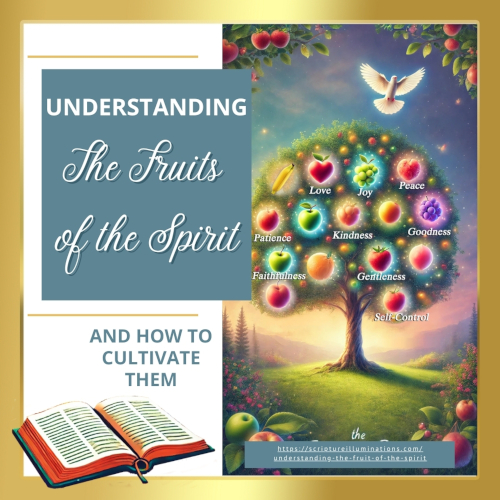
As followers of Christ, our ultimate goal is to live a life that is pleasing to God and reflects His character. One of the ways we can achieve this is by cultivating the fruits of the Spirit in our lives. In this article, we will delve deeper into what the fruits of the Spirit are and how we can intentionally cultivate them in our daily lives.
The Fruits of the Spirit Explained
There is a version of the Christian life that looks exhausting from the outside, and feels even more so from the inside. It is the version where you are constantly trying to be more loving, more patient, more gentle, more self-controlled. Where growth means gritting your teeth harder and trying to be a better person. Where every failure is another reminder that you are not measuring up.
If you have lived in that version, you may have noticed that it does not work particularly well. Self-discipline produces a certain kind of behaviour change, but it does not produce the transformation that the New Testament describes. You can become more outwardly controlled without becoming more inwardly kind. You can master the appearance of gentleness while the impatience still burns quietly underneath.
The passage that describes the fruit of the Spirit, found in Galatians 5:22-23, is not a list of character traits you are supposed to manufacture by trying harder. It is a description of what grows naturally from a particular kind of life, a life lived in union with the Spirit of God. Understanding what Paul actually means by “fruit” changes everything about how you approach the question of Christian character. And it begins not with the list itself, but with the word that gives the list its name.
Fruit, Not Deeds: The Most Important Word in the Passage
Before examining what the fruit of the Spirit is, it is worth pausing over how Paul introduces it. Just a few verses earlier in Galatians 5, he lists the “deeds of the flesh” (verse 19), actions that characterise life lived apart from God. But when he turns to describe the Christian life, he does not call these things “deeds of the Spirit” or “works of the Spirit”. He calls them “the fruit of the Spirit”.
That distinction matters more than it might first appear. Deeds are produced by effort. Fruit is produced by life. A branch does not produce apples by straining to do so; it produces apples by remaining attached to the tree and receiving what the tree provides. The fruit is the natural overflow of a healthy connection.
It is also significant that Paul uses the singular: not “the fruits of the Spirit” but “the fruit of the Spirit”. The nine qualities he names, love, joy, peace, patience, kindness, goodness, faithfulness, gentleness, self-control, are not nine separate items on a shopping list that you acquire one at a time. They are nine facets of a single character, the character of someone in whom the Holy Spirit is at work. They grow together, and their common source is the same.
Paul makes this structure explicit in Galatians 5:
But the fruit of the Spirit is love, joy, peace, patience, kindness, goodness, faithfulness, gentleness, self-control; against such things there is no law. (Galatians 5:22-23, NASB)
And then, immediately following the list:
Now those who belong to Christ Jesus have crucified the flesh with its passions and desires. If we live by the Spirit, let us also walk by the Spirit. (Galatians 5:24-25, NASB)
“Walk by the Spirit” — the Greek word for “walk” here is stoicheo, which means to proceed in step with, to keep in line with, as soldiers marching in formation. Paul is not saying: try harder. He is saying: stay in step with what the Spirit is already doing. The Christian life is not about generating the fruit by willpower; it is about maintaining the connection that allows the fruit to grow.
The Vine and the Branch: Where Fruit Actually Comes From
The night before His crucifixion, Jesus gave His disciples a picture of how this works. It is one of the most important passages in the New Testament for understanding Christian growth, and it is the passage that lies behind everything Paul writes about the fruit of the Spirit:
I am the true vine, and My Father is the vinedresser. Every branch in Me that does not bear fruit, He takes away; and every branch that bears fruit, He prunes it so that it may bear more fruit. You are already clean because of the word which I have spoken to you. Abide in Me, and I in you. As the branch cannot bear fruit of itself unless it abides in the vine, so neither can you unless you abide in Me. I am the vine, you are the branches; he who abides in Me and I in him, he bears much fruit, for apart from Me you can do nothing. (John 15:1-5, NASB)
Jesus does not say: produce fruit. He says: abide, and you will bear much fruit. The Greek word for “abide” is meno, which means to remain, to dwell, to stay. It is a word of settled, continuous connection, not a transient contact but a sustained indwelling. And it is this abiding, this remaining in Christ, that is the condition for fruitfulness.
Notice too that the Father is described as the vinedresser, the one who tends and prunes the vine. Pruning is painful. Branches that have borne fruit are cut back precisely because they bore fruit, so that they will bear more. If you have been through a season of loss, of stripping back, of circumstances that felt like they were cutting away things you were depending on, know that this is the vinedresser at work. The goal is not destruction but greater fruitfulness.
The question that follows from this passage is not “how do I produce more fruit?” but “how do I abide?” How do you maintain and deepen the connection that allows the fruit to grow? That is the real question behind any discussion of cultivating these qualities in your life, and it is a question we will return to at the end. But first, the fruit itself deserves careful examination.
Love: The Root of Everything Else
Paul places love first in the list, and this is not accidental. In his letter to the Colossians, he calls love “the perfect bond of unity” (Colossians 3:14). In 1 Corinthians 13, he argues that every other gift or virtue without love counts for nothing. Love is not just first on the list; it is the soil in which all the others grow.
The word Paul uses in Galatians 5 is agape, the same word used throughout the New Testament for God’s love toward humanity, and the love that characterises the community of those who follow Christ. This is not the love of sentiment or affection, which rises and falls with how we feel. Agape is volitional and self-giving; it chooses the good of the other person regardless of what that costs.
Paul’s famous description of love in 1 Corinthians 13 is best understood not as a set of instructions but as a portrait:
Love is patient, love is kind and is not jealous; love does not brag and is not arrogant, does not act unbecomingly; it does not seek its own, is not provoked, does not take into account a wrong suffered, does not rejoice in unrighteousness, but rejoices with the truth; bears all things, believes all things, hopes all things, endures all things. (1 Corinthians 13:4-7, NASB)
Notice how much of this description is negative, what love does not do. It does not brag, is not arrogant, does not act unbecomingly, does not seek its own, is not provoked, does not take into account a wrong suffered. The picture Paul paints is of a love that has been emptied of self-interest, of the need to be seen, of the habit of keeping score. This is not a love we manufacture; it is a love that, as he will say in Romans 5:5, is poured into our hearts by the Holy Spirit.
The highest demonstration of this love is seen in Christ Himself: “Greater love has no one than this, that one lay down his life for his friends” (John 15:13, NASB). The cross is not merely a theological transaction; it is the definition of what love looks like at full stretch. And it is this love, originating in God, poured through the Spirit, expressed in Christ, that is the source of the love that begins to grow in those who abide in Him.
Joy and Peace: What Circumstances Cannot Give or Take
Joy and peace are placed second and third in Paul’s list, and they belong together. Both are commonly confused with feelings that depend on circumstances. Joy is mistaken for happiness, the good mood that comes when things are going well. Peace is mistaken for the absence of conflict or difficulty. But Paul writes about both from prison (Philippians 4), which means he has a very different understanding of what these words mean.
The Greek word for joy in Galatians 5 is chara, which comes from the same root as charis, meaning grace. Joy, in the New Testament, is not a mood generated by favourable events; it is a response to who God is and what He has done. Psalm 16:11 makes clear where its source lies:
You will make known to me the path of life; In Your presence is fullness of joy; In Your right hand there are pleasures forever. (Psalm 16:11, NASB)
Fullness of joy is located in God’s presence, not in your circumstances. This is why Paul and Silas could sing hymns in a Philippian prison at midnight (Acts 16:25), not because their situation was good, but because their connection to the source of joy was unbroken. And it is why James can write to believers in suffering: “Consider it all joy, my brethren, when you encounter various trials” (James 1:2, NASB). He is not asking people to pretend suffering is pleasant; he is pointing them toward a joy that suffering cannot reach.
Peace in the list, eirene in Greek, corresponding to the Hebrew shalom, is similarly not the absence of trouble. Shalom carries the meaning of wholeness, completeness, of all things being as they should be. In the New Testament, it is rooted in reconciliation with God through Christ, and it extends outward from that centre into every relationship and circumstance. Paul’s description in Philippians 4 is one of the most striking in all of Scripture:
Be anxious for nothing, but in everything by prayer and supplication with thanksgiving let your requests be made known to God. And the peace of God, which surpasses all comprehension, will guard your hearts and your minds in Christ Jesus. (Philippians 4:6-7, NASB)
The peace that “surpasses all comprehension,” hyperechousa in Greek, meaning to surpass, to be superior to, is a peace that reason cannot explain and circumstances cannot undermine. It is not the peace of someone who has found a way to manage anxiety; it is the peace of someone who has handed their concerns to a God they trust, and found that He is sufficient. And Paul says it will “guard” your hearts and minds. The word is phroureo, a military term meaning to stand watch, to garrison. This peace is not passive; it actively stands between you and the anxiety that would otherwise flood in.
Patience and Kindness: Love Tested by People
If joy and peace describe the inner life of the believer, patience and kindness describe what that inner life looks like when it meets other people, especially difficult ones.
The word translated “patience” in Galatians 5 is makrothymia, literally “long-temperedness”, the opposite of short-temperedness. It is not passive endurance but active restraint: the capacity to hold back a natural response of anger or frustration, to give people space and time rather than reacting immediately. The other New Testament word often translated “patience” is hypomonē, steadfast endurance under pressure, but makrothymia is specifically patience with people, including people who are provoking you. James 1:4 speaks of letting “endurance have its perfect result”, the process of patience completing a work in you over time.
The life of Job, often cited as an example of patient endurance, is in some ways too easy an illustration, because Job’s suffering was external. The harder test of makrothymia is the person who seems to deliberately provoke you, the colleague who undermines, the family member who refuses to change, the friend who takes far more than they give. This is where patience is most genuinely tested, and where it is most clearly either the fruit of the Spirit or its absence.
Kindness, chrestotes in Greek, is closely related to patience. It is a disposition of generosity and goodwill toward others that does not wait for them to deserve it. Paul’s instruction in Ephesians 4 links kindness directly to the experience of having been forgiven:
Be kind to one another, tender-hearted, forgiving each other, just as God in Christ also has forgiven you. (Ephesians 4:32, NASB)
The logic runs from the received to the given: because you have been treated with a kindness you did not earn, you are now positioned to extend that same unearned kindness to others. Kindness, in this sense, is not a moral achievement; it is a natural response to having understood the grace you have been shown. The Good Samaritan parable (Luke 10:33-34) illustrates this in action: the one who stopped and helped was moved by “compassion”, not by the man’s deserving it, not by social expectation, but by an inner orientation toward the good of the other person.
Goodness and Faithfulness: Integrity Through and Through
Goodness and faithfulness might seem like the more straightforward entries in Paul’s list, but each carries more weight than a casual reading suggests.
The Greek word for goodness is agathosyne, a word that describes not merely doing good things but being good, having a settled orientation toward what is right and just. It is moral integrity lived out from the inside. Micah 6:8 provides one of the Old Testament’s clearest definitions of what this looks like in practice:
He has told you, O man, what is good; And what does the LORD require of you But to do justice, to love kindness, And to walk humbly with your God? (Micah 6:8, NASB)
To do justice, to love kindness, to walk humbly with your God; these three together give a picture of goodness as something embodied in how you actually live rather than how you are regarded. The woman Dorcas (Tabitha) in Acts 9:36 is described as being “abounding with deeds of kindness and charity which she continually did”, not as an occasional heroic act but as the pattern of her life. Goodness is not spectacular; it is consistent.
Faithfulness, the Greek pistis, the same word often translated “faith”, in the context of Galatians 5 refers to reliability, trustworthiness, the quality of keeping your word and honouring your commitments. The world runs on faithfulness: relationships, institutions, and communities are built on the expectation that people will do what they said they would do. When this quality is absent, everything becomes precarious. When it is present, it creates the kind of stability that allows others to flourish.
The faithfulness of Daniel is one of the most vivid illustrations in Scripture. When a royal decree forbade prayer to anyone but the king, Daniel “continued kneeling on his knees three times a day, praying and giving thanks before his God, as he had been doing previously” (Daniel 6:10, NASB). He did not make a dramatic stand; he simply continued what he had always done. Faithfulness is exactly that, not the grand gesture, but the continued practice in ordinary circumstances, including circumstances that make it costly.
Gentleness and Self-Control: Strength Under Discipline
The final two qualities in Paul’s list are often misunderstood, because both are mistaken for weakness when they are actually forms of strength.
The word translated “gentleness” is prautes, sometimes rendered “meekness” in older translations. In the ancient Greek world, the word was used for a horse that had been trained to obey its rider: an animal with enormous strength that had learned to place that strength under the direction of another. It is not weakness; it is controlled strength. Aristotle described prautes as the mean between excessive anger and its absence, the person who responds to provocation with the right measure of emotion, no more and no less. Paul describes it as part of the clothing of those who are “chosen of God, holy and beloved”:
So, as those who have been chosen of God, holy and beloved, put on a heart of compassion, kindness, humility, gentleness and patience. (Colossians 3:12, NASB)
The posture of gentleness is most clearly seen in Jesus’ interaction with the woman caught in adultery (John 8:10-11). He did not minimise what she had done. He did not pretend the law did not exist. But He met her with a composure that her accusers lacked entirely. He was not intimidated by their pressure, and He was not harsh toward her vulnerability. This is prautes in its fullest expression: the strength to hold truth and compassion together without sacrificing either.
Self-control, egkrateia in Greek, means literally “holding yourself in”, having mastery over your own impulses and desires. Paul describes what makes this possible in 2 Timothy 1:7:
For God has not given us a spirit of timidity, but of power and love and discipline. (2 Timothy 1:7, NASB)
The word translated “discipline” here is sophronismos, meaning sound-mindedness, the capacity for self-government. It is a Spirit-given quality, not a naturally developed one. The Joseph narrative in Genesis illustrates it starkly: faced with repeated, increasingly explicit advances from Potiphar’s wife, Joseph’s response is grounded not in personal strength but in a clear-eyed account of his responsibilities before God: “How then could I do this great evil and sin against God?” (Genesis 39:9, NASB). Self-control, in the biblical vision, is not the suppression of desire by willpower; it is the reorientation of desire toward what truly matters.
Transformation, Not Performance: Why This Matters
Having looked at the nine qualities Paul names, we need to come back to the question of how they grow. Because if the metaphor of fruit tells us anything, it is that you cannot force the outcome. You can do everything right externally, pray the right prayers, attend the right meetings, read the right passages, and still remain essentially unchanged. The history of Christian life is full of people who performed virtue without possessing it.
Paul addresses this directly in Romans 12:2:
And do not be conformed to this world, but be transformed by the renewing of your mind, so that you may prove what the will of God is, that which is good and acceptable and perfect. (Romans 12:2, NASB)
The word for “transformed” is metamorphoo, the word from which we get metamorphosis. It is the language of a change that goes all the way down, a change of nature rather than a change of behaviour. And Paul says it happens “by the renewing of your mind”, a process that is ongoing (the Greek is a present passive: it is being done to you, continuously, not a single event). The renewing of your mind means the gradual replacement of one set of assumptions, values, and ways of seeing with another, the mind of Christ.
This is why the cultivation of the fruit of the Spirit is inseparable from knowing God. The more clearly you see who He is, His love, His faithfulness, His patience with you, the more naturally His character begins to show up in yours. You become like what you spend time with and what you admire. Paul describes this process in 2 Corinthians 3:18: “But we all, with unveiled face, beholding as in a mirror the glory of the Lord, are being transformed into the same image from glory to glory, just as from the Lord, the Spirit” (NASB). Beholding and being transformed are not two separate activities; the beholding is what produces the transformation.
How to Abide: The Question Behind the Question
If the fruit grows from abiding in Christ, then the real question is not “how do I become more patient?” or “how do I love people who are hard to love?” but “how do I maintain and deepen the connection that allows these things to grow?”
Scripture points to several practices that are not means of earning fruitfulness but conditions for it, things that keep the connection open and the soil prepared.
Time in Scripture is primary. Not Scripture as a performance, the dutiful reading of a quota, but Scripture as the living voice of the God you are trying to know. The more deeply you understand who God is, what He has done, how He has acted in history and in the story of His people, the more the framework through which you see your own life begins to shift. Your patience with difficult people is connected to understanding how patiently God has dealt with you. Your capacity for kindness is connected to knowing the kindness shown to you. You cannot love like this on your own account; you love because you have been loved (1 John 4:19).
Prayer is the other side of this. Not merely prayer as petition, the presenting of a list of needs, but prayer as conversation, as the ongoing acknowledgment that you cannot produce what you need by yourself and that you are dependent on the Spirit’s work. Paul’s instruction in Philippians 4:6-7 to bring everything to God “with thanksgiving” is itself a form of training in joy and peace, because thanksgiving orients you toward what God has already done, and that orientation changes how you face what lies ahead.
And there is the community of believers. You cannot abide in Christ in isolation from His body. Colossians 3:12-16 weaves together the qualities of the fruit, compassion, kindness, humility, gentleness, patience, forbearance, forgiveness, love, and locates them in the context of a community of people living together, teaching one another, bearing one another’s burdens. The fruit is personal, but it is grown and expressed in community. Your growth in patience is tested and refined by real people, in real relationships, in real circumstances that you did not choose.
The Promise of the Fruit
The fruit of the Spirit is not a standard you are failing to meet. It is a promise of what the Spirit of God does in a life that is genuinely His. Paul closes Galatians 5 with the reminder that those who belong to Christ have “crucified the flesh with its passions and desires” (verse 24), not perfectly, not without struggle, but definitively in terms of allegiance. The old drives are not in charge any more.
This means that the qualities described in Galatians 5:22-23 are not foreign to you if you are in Christ. They are, in a real sense, already there, planted by the Spirit at the moment of your new birth, pressing toward expression as the connection to the vine is maintained and deepened. The work is not to manufacture them from nothing but to remove what is blocking them, the habits of self-protection, the reflexes of pride, the anxieties that make you want to control everything, and to keep returning to the One in whom they have their source.
The nine qualities Paul names are, in the end, a portrait of Jesus. They are what love looks like when it has been tested. What joy looks like when it has survived grief. What patience looks like when it has had every reason to give up. What gentleness looks like when it has been provoked. If you want to know what the fruit of the Spirit looks like in a human life, you look at Him.
And the extraordinary claim of the New Testament is that, as you abide in Him, you begin to bear the same fruit.
All Scripture quotations are from the New American Standard Bible (NASB) 1995 edition.