Almost every Christian you ask has a story about baptism. For some it was a moment of tears and public joy, surrounded by people who knew them. For others it was quiet, private, almost trembling. For some it happened in infancy, surrounded by a faith community making promises on their behalf. And for a few, baptism still lies ahead, a step not yet taken.
Whatever your experience, baptism is one of those practices where the outward action and the inward meaning press in on each other so tightly that it is almost impossible to separate them. You go under water and come back up, or water is poured over your head, or sprinkled. Either something of enormous weight is happening, or it is the most elaborate ceremony for nothing. There is no neutral position.
The New Testament treats baptism with a seriousness that can make some Christians uncomfortable, because the language it uses is stronger than what we might expect if baptism were purely a symbol of something already complete. But it also treats baptism in a way that preserves the absolute priority of faith and grace. Getting both of these things right requires sitting with the texts carefully, including the ones that are genuinely difficult.
What Baptism Means: Starting with the Greek
The word translated "baptism" throughout the New Testament is the Greek baptizo, which means to immerse, to submerge, to plunge into; and in some extended uses, to wash or to overwhelm. The imagery is of something being fully enveloped by a surrounding medium. When John the Baptist offered a "baptism of repentance", the word carried a vivid physical picture: a person submerged in the Jordan River, a visible going down and coming back up.
But baptism was not John's invention. The Jewish practice of immersion as ritual cleansing (mikvah) provided the cultural background. Full immersion in water signified purification, a transition from one state to another. John took this familiar form and loaded it with new content: repentance, the coming of God's kingdom, and preparation for the one who was coming after him. What was already a meaningful ritual became the frontier of something entirely new.
Mark 1:4 describes it plainly:
"John the Baptist appeared in the wilderness preaching a baptism of repentance for the forgiveness of sins."
(Mark 1:4, NASB)
John's baptism was preparatory, pointing toward a greater reality than it could itself accomplish. He was explicit about this: "I baptized you with water; but He will baptize you with the Holy Spirit" (Mark 1:8, NASB). Water baptism pointed beyond itself, toward the Spirit's work that would come with Jesus. This movement from the preparatory to the fulfilled is part of what makes Christian baptism something altogether different from John's.
Jesus Steps into the Water: What His Baptism Inaugurates
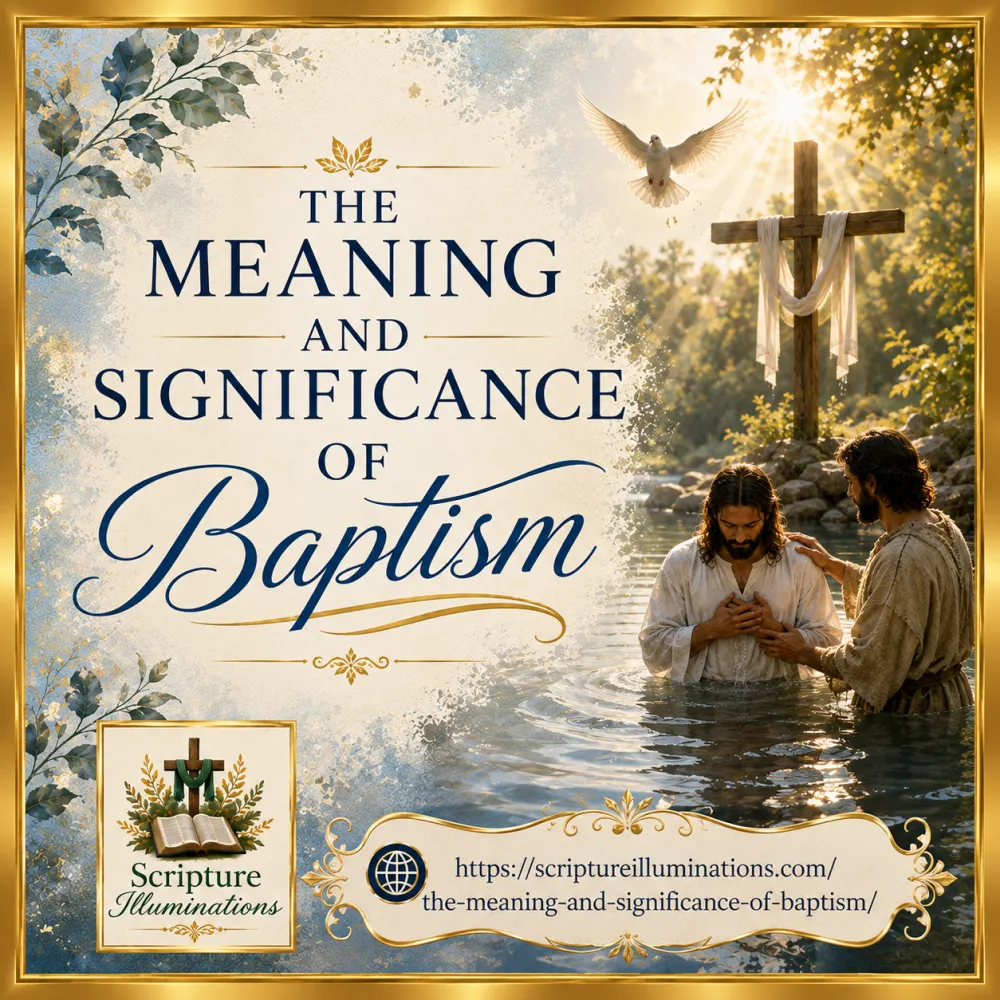
The most theologically loaded baptism in the Gospels is the one that required no repentance. Jesus had nothing to confess and nothing to turn from, yet He presented Himself to John at the Jordan. When John tried to stop Him, saying "I have need to be baptized by You, and do You come to me?", Jesus' answer was not an explanation but an instruction: "Permit it at this time; for in this way it is fitting for us to fulfill all righteousness" (Matthew 3:14-15, NASB).
What happened next was the Trinitarian moment that opened His public ministry:
"After being baptized, Jesus came up immediately from the water; and behold, the heavens were opened, and he saw the Spirit of God descending as a dove and lighting on Him, and behold, a voice out of the heavens said, 'This is My beloved Son, in whom I am well-pleased.'"
(Matthew 3:16-17, NASB)
Three persons, one moment. The Son rises from the water. The Spirit descends. The Father speaks. This is the first fully explicit Trinitarian scene in the Gospels, and it happens at a baptism. The name in which Christian baptism is administered, "in the name of the Father and the Son and the Holy Spirit" (Matthew 28:19, NASB), is not an abstract formula. It is rooted in this event, the moment when all three were present together as the Son took up His mission.
Why did Jesus need to be baptised? The short answer is: He did not need it for Himself. But in presenting Himself for a baptism of repentance on behalf of sinners, He was identifying Himself with the people He had come to save. He was taking His place among them, not as one who needed to repent, but as the one who would bear what their repentance pointed toward. His baptism was a preview of His entire mission: solidarity with sinners, immersion in their condition, so that they could be raised with Him into newness of life.
Buried and Raised: The Heart of Paul's Theology of Baptism
The passage that lies at the theological core of Christian baptism is Romans 6. Paul is not writing a treatise on baptism; he is addressing a practical question about whether grace means sin doesn't matter any more. But in answering that question, he unpacks what baptism actually means with a force that is difficult to overstate:
"Or do you not know that all of us who have been baptized into Christ Jesus have been baptized into His death? Therefore we have been buried with Him through baptism into death, so that as Christ was raised from the dead through the glory of the Father, so we too might walk in newness of life. For if we have become united with Him in the likeness of His death, certainly we shall also be in the likeness of His resurrection."
(Romans 6:3-5, NASB)
The phrase "baptized into Christ Jesus" carries extraordinary weight. The Greek preposition eis ("into") indicates union, not merely association. To be baptised into Christ is to be incorporated into Him, to be identified with everything He did and everything He is. The immersion in water dramatises what has happened spiritually: the old self going down into death with Christ, and coming back up into the resurrection life that belongs to the risen Lord.
Paul's language here is not casual. He says believers have "become united with Him". The Greek is symphytoi, which literally means "grown together with", as in grafted vines or fused plants. This is not a loose association or a formal membership. It is organic union. The death that happened at the cross is, in a genuine sense, the believer's death too; the resurrection is theirs too. And baptism is the enacted declaration and seal of that union.
Galatians 3:27 presses the same reality with different imagery:
"For all of you who were baptized into Christ have clothed yourselves with Christ."
(Galatians 3:27, NASB)
"Clothed yourselves with Christ." The metaphor of putting on clothing implies a total envelopment, baptism as the moment when Christ becomes, as it were, your identity, your covering before God. And what follows immediately in verse 28 is the breaking down of every social and ethnic division: "There is neither Jew nor Greek, there is neither slave nor free man, there is neither male nor female; for you are all one in Christ Jesus." Baptism into Christ creates a new community defined entirely by its union with Him, cutting across every other distinction human society draws.
The Hard Passages: What Does Baptism Actually Do?
This is where many Christians become uneasy, because the New Testament says things about baptism that resist reduction to "it's just a symbol". Two passages in particular push back hard against any interpretation that treats baptism as a purely optional, purely symbolic ceremony with no inherent significance.
The first is Peter's sermon at Pentecost:
"Peter said to them, 'Repent, and each of you be baptized in the name of Jesus Christ for the forgiveness of your sins; and you will receive the gift of the Holy Spirit.'"
(Acts 2:38, NASB)
The preposition eis ("for") in "for the forgiveness of your sins" is the same word used in Matthew 26:28 where Jesus says His blood is poured out "for the forgiveness of sins". Peter links repentance and baptism together in a single statement, with forgiveness and the gift of the Spirit as the result. He does not say: repent, receive forgiveness, and then get baptised as a symbol of what has happened. The connection is direct.
The second passage is Peter again, in his first letter:
"Corresponding to that, baptism now saves you—not the removal of dirt from the flesh, but an appeal to God for a good conscience—through the resurrection of Jesus Christ."
(1 Peter 3:21, NASB)
"Baptism now saves you." Peter says that plainly. He immediately clarifies that he is not talking about the water doing something mechanical. It is not the physical washing that saves. But he does not say baptism has no saving significance. He defines what baptism is: "an appeal to God for a good conscience." The Greek word for "appeal" here is eperotema, which carries the sense of an earnest request or pledge. Baptism is the moment of the believer's conscientious response to God, and Peter says this, through the resurrection of Christ, saves.
And from Paul's conversion account, the words of Ananias:
"Now why do you delay? Get up and be baptized, and wash away your sins, calling on His name."
(Acts 22:16, NASB)
These passages do not sit easily with a theology that makes baptism purely symbolic and entirely post-salvation. But they also do not sit easily with a sacramentalism that locates saving grace in the water itself, independent of faith and repentance. The New Testament holds both realities in tension without resolving them into a neat system.
The key is what Peter says in 1 Peter 3:21 about the conscience. Baptism is not magic and it is not empty. It is the point at which the believer's faith and repentance and surrender are enacted bodily, publicly, before God and witnesses. It is the moment of conscientious response to the gospel. Paul in Romans 10:9-10 describes the same reality in terms of confession: "if you confess with your mouth Jesus as Lord, and believe in your heart that God raised Him from the dead, you will be saved." Baptism is the comprehensive, embodied form of that confession.
What saves is not the water. What saves is the grace of God received through faith (Ephesians 2:8-9). But baptism, in the New Testament, is so interwoven with that reception that treating it as optional or trivial does justice to neither the apostles nor the Christ who commanded it. When people ask whether baptism saves, the honest answer is this: not the water, but not nothing either. Baptism is the enacted surrender of faith, and faith is what saves.
The Waters of the Old Testament: Reading Backwards
The New Testament's treatment of baptism is not unrooted. It draws on a deep Old Testament soil of water and salvation, where passing through water is associated with deliverance and new beginnings.
The passage Peter draws on in 1 Peter 3 is Noah and the ark. He describes the eight people who "were brought safely through the water" and then says: "Corresponding to that, baptism now saves you." The Greek word for "corresponding to" is antitypon. Noah's salvation through water is the type; Christian baptism is the antitype, the reality the type was pointing toward. The flood was judgment; the ark was salvation through judgment. Baptism is identification with Christ who passed through judgment on our behalf and came through death to resurrection.
Paul makes a similar move in 1 Corinthians 10:2, where he describes the Israelites as having been "baptized into Moses in the cloud and in the sea." Their passing through the Red Sea was, typologically, a baptism. They left slavery behind. They passed through waters of death, since Pharaoh's army drowned in those same waters. They emerged on the other side into a new life under God's covenant. The parallels to Christian baptism are not accidental; Paul draws them deliberately.
What this typological reading does is locate Christian baptism within the great sweep of God's saving action through history. It is not a ritual invented by the early church to mark new members. It is the fullest expression of something God has been doing from the beginning: bringing His people through water from death to life, from slavery to freedom, from the old age to the new.
A New Creation: What Comes Up from the Water
Paul's language in Romans 6 about the "newness of life" that follows baptism connects directly to one of his most concise and powerful statements about the Christian life:
"Therefore if anyone is in Christ, he is a new creature; the old things passed away; behold, new things have come."
(2 Corinthians 5:17, NASB)
The phrase "new creature", kaine ktisis in Greek, means new creation. Paul is not talking about minor improvements to an existing life. He is describing a creation-level event: the person who comes up from the waters of baptism is, in a real sense, a new creature. What they were, their identity under Adam, their standing before God, their relationship to sin and death, has passed away. Something new has come.
This does not mean the old self immediately feels gone. The rest of Romans 6 is precisely about working out the implications of this new identity in practice: "Even so consider yourselves to be dead to sin, but alive to God in Christ Jesus" (Romans 6:11, NASB). The word "consider", logizomai, means to reckon, to count as true, to act on the basis of. Baptism declares something that faith is then called to continually reckon with, to live from, to keep returning to as the defining truth about who you now are.
This is why, in the early church, baptism was never treated as the beginning of a life that would then proceed unchanged. It was the formal end of one mode of existence and the formal beginning of another. The garments worn before baptism were laid aside; white robes were often worn coming up from the water. The symbolism was not decorative. It enacted the truth that Paul is describing: the old has gone.
Immersion, Pouring, Sprinkling: The Question of Mode
Christians have practised baptism in three main modes: immersion (full submersion under water), affusion (pouring water over the head), and aspersion (sprinkling). This is one of the points at which genuine, thoughtful Christians disagree, and the disagreement is rooted in real exegetical questions, not mere preference.
The word baptizo, as noted, primarily means to immerse or submerge. The imagery of burial and resurrection in Romans 6 fits immersion most naturally, since you cannot depict burial and rising again through sprinkling. The accounts of Jesus' baptism, of Philip baptising the Ethiopian in Acts 8:38-39, and of John baptising "because there was much water there" (John 3:23) all fit comfortably with immersion. Baptist and many evangelical traditions hold immersion as both the New Testament mode and the one most expressive of baptism's symbolism.
The case for pouring and sprinkling rests partly on the practical realities of large-scale baptism in places like Jerusalem at Pentecost (three thousand people in a single day), partly on the use of the cognate word baptizo in the Greek Old Testament for ritual washings that could not have involved full immersion, and partly on the consistent practice of many churches across the first centuries. The Didache, a first- or second-century Christian manual, explicitly permits pouring if running water is unavailable. Paedobaptist traditions (those who baptise infants) generally use sprinkling or pouring.
What this survey suggests is that the mode question is genuinely open, that good scholars and faithful Christians have landed in different places, and that the honest thing is to acknowledge the strength of the arguments for immersion as the primary mode while recognising that the church has never been unanimous on this, and that the meaning of baptism does not ultimately stand or fall with the quantity of water involved. The question of infant versus believer baptism is a separate and deeper debate, rooted in different understandings of the new covenant community, and deserves careful treatment on its own terms.
The Command and the Community: Baptism in the Great Commission
Whatever the mode and whatever the precise theology, the command itself is unambiguous. The risen Christ issued it as His final instruction before ascending:
"Go therefore and make disciples of all the nations, baptizing them in the name of the Father and the Son and the Holy Spirit, teaching them to observe all that I commanded you; and lo, I am with you always, even to the end of the age."
(Matthew 28:19-20, NASB)
Several things are worth noticing here. First, the grammar: the main verb is "make disciples". Baptising and teaching are the two participles that describe how disciple-making happens. They are not optional extras but the means of the commission. You make disciples by baptising and by teaching. Baptism is structurally essential to the process of forming disciples, not an optional step that enthusiastic believers might take.
Second, the name: "in the name of the Father and the Son and the Holy Spirit." This is not three names but one name shared by three persons. To be baptised in this name is to be brought into a relationship with the God who is, by nature, a communion of love. The community that baptism creates, the church, is meant to reflect the unity in diversity that characterises the God in whose name it has been gathered.
The early church obeyed this command without reservation. In Acts 2:41, those who received Peter's message "were baptized; and that day there were added about three thousand souls". Baptism and conversion are treated as a single complex event throughout Acts. The Ethiopian eunuch is baptised immediately upon understanding the gospel (Acts 8:36-38). The Philippian jailer is baptised the same night of his conversion (Acts 16:33). The pattern is consistent: baptism follows faith as night follows day, and the question of deferring it is never raised.
Living from Your Baptism
Martin Luther, whose theology of grace was as fierce as anyone's, used to say when tempted or discouraged: "I am baptised." Not "I was baptised", the past tense that locates baptism in a memory, but "I am baptised", the present tense that treats it as a living identity. This is the practical force of Paul's instruction to "consider yourselves dead to sin, but alive to God in Christ Jesus." Baptism is not only something that happened; it is something you are.
Romans 6:4 speaks of walking "in newness of life". The word for "walk", peripateo, means to conduct oneself, to order one's life, to live moment by moment. The newness of life that baptism declares is not a completed state but a direction of travel, a new orientation that is worked out daily in the choices, habits, relationships, and practices that make up a life. You come up from the water into a life that you are now called to inhabit consistently with who you have become.
This has real consequences. If baptism is your identification with Christ's death, then the resentments, the habits, the dispositions that belong to the old self have no more claim on you than they do on a dead person. Dead people do not keep accounts of wrongs. Dead people are not anxious about status. Dead people have no reputation left to protect. And people who have risen with Christ have been given, in His resurrection, a new life that is not defined by those things. Baptism declares this. The rest of the Christian life is the slow, stumbling, Spirit-assisted project of living consistently with what baptism has declared.
If you have not yet been baptised and believe yourself to be a follower of Christ, the question worth sitting with is not "is it strictly necessary?" but "what is it that I am waiting for?" The New Testament does not picture a category of convinced Christians who deferred baptism indefinitely because it felt like a big step. The step is indeed large; that is the point. But the New Testament treats it as the first step, not a later optional one.
And if you were baptised years ago, perhaps as an infant, perhaps as a teenager, perhaps in a moment you barely remember, the question is not whether to do it again but whether you are living from it. Whether the death declared in those waters is something you are actually reckoning with in how you treat people, spend money, handle disappointment, face temptation. Whether the resurrection declared in that moment is what you are walking in, not in the sense of a forced Christian cheerfulness, but in the sense of a life genuinely reoriented toward the God in whose name you were named.
The Waters Still Speak
Every baptism performed is a proclamation. It says: there is a death that can undo the grip of every other death. There is a resurrection that has already begun. There is a new creation breaking into the old one, a community of people who have passed through the waters and come up on the other side into the life of God.
The waters are not merely symbolic. They are not salvific in the way that Christ's blood is salvific. But they are the visible, enacted, embodied form of the most decisive event in a person's existence: the moment of union with Christ in His death and resurrection, the moment of entry into the community of those who bear His name, the moment of conscientious appeal to a God who has promised to hear.
When Jesus stepped into the Jordan, the Spirit descended and the Father spoke. Every Christian baptism since carries an echo of that moment, the same God present, the same Spirit at work, the same voice that speaks over every person who comes up from the water and begins to live in the name into which they have been baptised.
Living It Out
- If you follow Christ and have not been baptised, sit honestly with Ananias's question: "Now why do you delay?" (Acts 22:16). Speak to your church about taking the step.
- If you were baptised long ago, live from it. Practise Luther's present tense in temptation: not "I was baptised" but "I am baptised."
- Reckon daily (Romans 6:11): consider yourself dead to sin and alive to God, and act on what has been declared true of you.
- Let the old self's claims fall away: dead people keep no accounts of wrongs, protect no reputations, and are not anxious about status. You came up from the water into newness of life.
- Hold the mode question with charity: faithful Christians differ, and the meaning of baptism does not stand or fall with the quantity of water.
Prayer: Father, I was buried with Christ and raised with Him; teach me to walk today in the newness of life my baptism declared. Amen.
_____________________________________________
Scripture quotations taken from the New American Standard Bible® (NASB), Copyright © 1960, 1971, 1977, 1995 by The Lockman Foundation. Used by permission. All rights reserved. lockman.org