
Article List – Page 2 –
 16. Developing A Deeper Relationship With God
There is a phrase so common in Christian circles that it has almost lost the capacity to surprise: “a personal relationship with God”. You hear it in sermons, read it in devotionals, and encounter it in the conversion stories of Christians across centuries. And yet, if you stop to think about what it actually claims, it is one of the most audacious things a human being can say. A relationship, personal and ongoing, with the Creator and Sustainer of the universe, the one before whom the seraphim cover their faces. The claim is not modest.
Most Christians affirm it without much trouble. Fewer would say with confidence that they experience it. There is often a gap between the language of intimacy and the actual texture of their spiritual life: the prayers that feel as though they travel no further than the ceiling, the Scripture reading that has become a dutiful routine rather than a living encounter, the sense of God as a theological fact rather than a living presence. The question is not whether the relationship is real but how to inhabit it more fully.
This article is an attempt to take that question seriously. It will not offer a five-step programme, because this is not that kind of subject. What it will do is examine what Scripture actually says about what it means to know God, and specifically to address the things that the standard treatment of this topic tends to miss: the foundational question of who initiates this relationship and why that matters entirely; the costly and specific friendship Jesus extends in John 15; the honest realities of prayer and Scripture engagement; and what to do in the seasons when God seems unreachably distant. Real relationship involves all of these dimensions.
 17. Embracing Repentance: A Deeper Journey of Transformation in Christian Faith
Most Christians have a complicated relationship with the word “repentance”. They know it matters. They have heard it preached, and they understand in principle that it is central to the Christian life. And yet, for many believers, the practice of repentance tends to produce something closer to guilt than to freedom, something that leaves them circling their failures rather than moving away from them. They confess, they resolve, they fall again, they confess once more, and the cycle continues without the transformation they were promised.
Some of this is simply the difficulty of change, which is real. But some of it reflects a misunderstanding of what repentance actually is. If repentance is primarily about feeling sufficiently sorry, then it degenerates into a performance of remorse that measures itself by the intensity of the guilt experienced. If it is primarily about making promises to do better, it becomes an increasingly demoralising cycle of failure. If it is understood as the mechanism by which forgiveness is earned, it becomes a burden no one can carry.
Scripture’s account of repentance is more interesting and more liberating than any of these framings. It is a word about direction more than feeling, about movement more than emotion, about who you are returning to rather than merely what you are leaving behind. Understanding this properly makes repentance not something to dread but something to pursue, because it is the path back to the only relationship that can satisfy the deepest longings of a human life.
18. Embracing Divine Protection and Guidance Through Scripture
There are seasons in life when the ground you thought was solid begins to shift. A diagnosis comes back with words you were not prepared to hear. A relationship fractures in ways that seemed impossible. A future you had planned unravels overnight. In moments like these, something primal in us reaches out, searching for something that will hold.
The Christian faith does not offer immunity from these moments. Scripture is honest enough to acknowledge that the righteous walk through valleys, face enemies, and cry out in the dark. What Scripture does offer is something far more durable than a trouble-free life: the assurance that the God who created all things is present with His people, that He is not passive in their suffering, and that no force in existence can ultimately separate them from His love.
This article is an exploration of some of the Bible’s richest passages on divine protection and guidance. These are not simple comfort texts to be glanced at in a crisis and then set aside. They are deep wells that deserve sustained attention. They reveal who God is, what He has committed Himself to, and what it means, practically and spiritually, to live under His care.
 19. Overcoming Doubt and Building a Stronger Faith
If you have ever sat in church, sung the words of a hymn, and felt nothing, you will know the particular loneliness of doubt. Not the clean, philosophical kind of doubt that makes for interesting conversation, but the kind that surfaces at two in the morning when life has not gone the way you expected. The kind where the words you used to believe ring hollow, and you are not sure if the problem is God or you.
A large portion of Christian life seems to be spent pretending this does not happen. Doubt is treated as the enemy of faith, something to be confessed and quickly overcome, the spiritual equivalent of a head cold. The sooner you get back to certainty, the better.
But Scripture tells a more honest story. The Bible is full of people who believed and struggled, who trusted and questioned, who cried out to God in anguish and demanded answers. Faith, as the Bible presents it, is not the absence of doubt. It is something deeper and more durable: a trust that holds even when understanding fails.
This article is an attempt to take doubt seriously, on its own terms, with the full weight of Scripture behind it. Not to explain it away, but to understand what it actually is, why it arises, what the Bible says about it, and how a living faith can be built in the midst of it rather than only after it has been resolved.
 20. Exploring the Depths of Hope in Times of Trial
There are seasons in life when hope feels less like a settled conviction and more like a word you’re no longer sure you believe. The diagnosis arrives. The marriage fractures. The prayer goes unanswered for so long that you start to wonder whether you’re praying into silence. In those moments, the word hope can feel like a cruelty, something people say when they don’t know what else to offer.
But the hope Scripture describes is not that kind of hope. It is not optimism in disguise. It is not a cheerful attitude you can conjure by focusing on the positive. Biblical hope is something far more solid and far more demanding, and far more honest about the reality of suffering. It is worth taking the time to understand what it actually is, because if you mistake it for something thinner, you will lose it the first time life gets truly hard.
This article is for those who want to go deeper than the surface. It is for people who have sat in the dark and found that easy answers did not help, and who want to know what the Bible actually says about hope, not as a platitude, but as a lifeline.
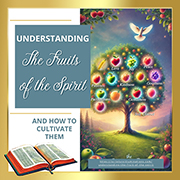 21. Understanding the fruits of the Spirit and how to cultivate them
There is a version of the Christian life that looks exhausting from the outside, and feels even more so from the inside. It is the version where you are constantly trying to be more loving, more patient, more gentle, more self-controlled. Where growth means gritting your teeth harder and trying to be a better person. Where every failure is another reminder that you are not measuring up.
If you have lived in that version, you may have noticed that it does not work particularly well. Self-discipline produces a certain kind of behaviour change, but it does not produce the transformation that the New Testament describes. You can become more outwardly controlled without becoming more inwardly kind. You can master the appearance of gentleness while the impatience still burns quietly underneath.
The passage that describes the fruit of the Spirit, found in Galatians 5:22-23, is not a list of character traits you are supposed to manufacture by trying harder. It is a description of what grows naturally from a particular kind of life, a life lived in union with the Spirit of God. Understanding what Paul actually means by “fruit” changes everything about how you approach the question of Christian character. And it begins not with the list itself, but with the word that gives the list its name.
22. The Meaning and Significance of Baptism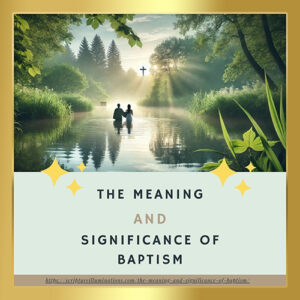
Almost every Christian you ask has a story about baptism. For some it was a moment of tears and public joy, surrounded by people who knew them. For others it was quiet, private, almost trembling. For some it happened in infancy, surrounded by a faith community making promises on their behalf. And for a few, baptism still lies ahead, a step not yet taken.
Whatever your experience, baptism is one of those practices where the outward action and the inward meaning press in on each other so tightly that it is almost impossible to separate them. You go under water and come back up, or water is poured over your head, or sprinkled. Either something of enormous weight is happening, or it is the most elaborate ceremony for nothing. There is no neutral position.
The New Testament treats baptism with a seriousness that can make some Christians uncomfortable, because the language it uses is stronger than what we might expect if baptism were purely a symbol of something already complete. But it also treats baptism in a way that preserves the absolute priority of faith and grace. Getting both of these things right requires sitting with the texts carefully, including the ones that are genuinely difficult.
 23. The Impact of Prayer
Most people have prayed, or tried to. There is something in human beings that reaches toward the unseen at moments of great need or great wonder, something that looks remarkably like prayer even when it doesn’t use that word. But for Christians, prayer is not simply an instinct or a cultural habit. It is, according to Scripture, genuine communication with the God who made the universe and who has made Himself known as Father.
That claim is either the most extraordinary thing imaginable or a comfortable illusion. And the tension between those two possibilities is something most honest believers feel at some point. Prayer can feel alive and intimate one week and hollow the next. Some prayers seem to be answered in ways that leave you speechless; others seem to dissolve into nothing. The Bible does not pretend otherwise. What it does is give prayer a theological foundation so solid that it can hold the weight of both the joy and the confusion.
This article is an attempt to look at that foundation: what prayer actually is, what makes it possible, how Jesus both modelled it and taught it, what the Spirit does when we don’t know how to pray, and what honest Christian experience tells us about the harder questions that prayer raises.

24. Salvation in Christianity: A Deeper Understanding
The word “salvation” can start to sound like church vocabulary, a word used so often it loses its weight. But the concept it names is the single most significant claim Christianity makes. It is the answer to the deepest problem human beings face, accomplished at enormous cost, offered as a gift, and carrying consequences that extend beyond this life into eternity. It is worth taking the time to understand what it actually means.
This article does not assume you are new to the Christian faith. But it does assume that salvation, like grace, like forgiveness, like love, is the kind of thing we think we understand until we sit with it more carefully and discover there is far more there than we first saw. The goal is not a summary but a serious engagement: with what the problem is, how God addressed it, what the different dimensions of salvation look like in Scripture, and what it means to receive it.
 25. The Power of Praise and Worship
Ask most Christians what worship is and they will describe a moment: a song that broke them open, a Sunday morning when the music stopped and the room went still, a private morning of prayer that felt genuinely like contact with the living God. These are real experiences and they matter. But if worship is only a feeling we reach for in the right conditions, it is far smaller than what the Bible actually describes.
Scripture uses several different words for worship, and the variety itself is instructive. It encompasses the posture of a person prostrating themselves in reverence, the daily life of someone who has surrendered their will to God, the gathered assembly of a community offering praise together, the raw honesty of a soul crying out in darkness with nowhere else to turn. All of these are worship. Understanding what Scripture says about worship means taking all of them seriously, not just the ones that feel good.
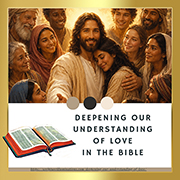 26. Deepening our Understanding of Love in the Bible
The word “love” appears more than five hundred times across the pages of Scripture, and it sits at the centre of everything the Bible says about God, about human beings, and about how the two are meant to relate to each other. Jesus summarises the entire law in terms of love. John declares that God is love, not merely that He is loving. Paul places love above faith and hope as the greatest of the three enduring virtues. Whatever else Christianity is, it is inescapably a religion about love.
Yet love is also one of the most misunderstood words in our culture. In English, a single word carries the weight of an enormous range of experiences: the tenderness of a parent for a child, the passion of romantic devotion, the loyalty of deep friendship, the compassion that moves toward a stranger in need. In Greek, the language of the New Testament, different words exist for different kinds of love, and understanding these distinctions opens up the biblical teaching considerably.
But before we examine what love is, Scripture insists on something foundational: we do not generate love from within ourselves and then offer it to God or others. We receive it first. First John 4:19 states this plainly: “We love, because He first loved us.” Any serious engagement with biblical love has to begin there.
 27. Overcoming fear and anxiety with faith
There is a command in the Bible that appears more often than almost any other: “Do not be afraid.” Jesus says it. Angels say it on arrival. God says it to Abraham, to Hagar, to Moses, to Joshua, to Elijah. It appears in some form over three hundred times across the pages of Scripture. That frequency is not accidental. It is the frequency of a God who knows His people well, who knows that fear is one of the most persistent and disabling experiences of human life.
The repetition also tells us something else: God would not need to keep saying “do not be afraid” if His people were never afraid. The disciples were afraid in the storm. Elijah was afraid after his greatest victory. David was afraid when surrounded by enemies. Peter was afraid when he denied knowing Jesus. Fear is not a mark of weak faith, and the Bible does not treat it as one. What Scripture does, over and over, is speak to fear directly, not dismissing it but redirecting it, not promising exemption from frightening circumstances but offering something more durable than exemption.
This article works through the biblical teaching on fear and anxiety. It is not a guide to eliminating anxious feelings; the Bible does not promise that. It is an attempt to understand what Scripture actually says, including the parts that are harder to sit with.
 28. Hope of Salvation for Unsaved Family Members
There is a particular kind of grief that belongs to believers alone: watching someone you love live as though God does not exist. A spouse who once knelt beside you in prayer, now dismissive. Children who were baptised, who memorised Scripture, who sang in church, now absent from anything resembling faith. Family members you love deeply, whose eternal destiny you cannot see and cannot control. If you have sat with this grief, you know how it can hollow out the night.
The question is not really whether God can save your family. Every honest believer knows He can. The deeper, more anguished question is whether He will. And beneath that: is there anything in Scripture that gives a believing spouse, parent, or sibling solid ground to stand on, not wishful thinking, not positive confession, but actual biblical hope?
This article is an attempt to answer that question carefully and honestly. There is real ground for hope in Scripture. But that hope is only as sturdy as it is honest, and so we will also need to acknowledge what the Bible does not promise, and sit with the tension that creates. Cheap comfort is no comfort at all. What follows is an attempt to give you the real thing.
29. Here & Now in Jesus: The Earth-Side Benefits Series – Introduction and Series Structure
Coming Soon
30. Here & Now in Jesus: The Earth-Side Benefits Series – Article 1
Coming Soon
Articles List – Page 1 – | Page 2 | Page 3 |