
Article List Page 1

In Chronological Order from Oldest to Newest:
 1. Cultivating a Heart of Gratitude and Thanksgiving
You know the feeling. You scroll through social media and see someone else’s vacation, promotion, or picture-perfect family, and something in your chest tightens. Or perhaps it’s simpler than that: the bills pile up, the diagnosis comes back uncertain, the relationship frays at the edges, and gratitude feels not just difficult but almost offensive. How can I be thankful when life is this hard?
This tension between the biblical call to thanksgiving and the raw reality of our circumstances is one every believer faces. Scripture does not brush past it. In fact, the Bible’s teaching on gratitude is richer, harder, and more transformative than any list of “five tips for being more thankful.” What we find in Scripture is nothing less than a reorientation of the soul, a way of seeing God, ourselves, and our circumstances that produces genuine, lasting thanksgiving even when life hurts.
This is not about positive thinking. It is not about pretending things are fine when they are not. Biblical gratitude is something far more robust, a posture of the heart that rests on the unchanging character of God and the finished work of Christ. Let us explore what Scripture actually says about cultivating this kind of heart.
 2. Applying Biblical Principles to Modern-Day Issues
We live in a world that moves fast. Technology evolves, social norms shift, and new ethical questions emerge that would have been unimaginable to previous generations. As Christians who believe Scripture is God’s authoritative Word, we face a genuine challenge: how do we take an ancient text, written thousands of years ago to people in vastly different circumstances, and faithfully apply it to the complexities of modern life?
This is not a new question. Every generation of believers has had to navigate the task of living faithfully in their particular moment in history. But the question feels especially urgent in our day, when the pace of change seems to accelerate with each passing year, and when Christians themselves often disagree sharply about how biblical principles should inform our engagement with contemporary issues.
The good news is that Scripture itself provides guidance; not always easy answers to specific questions, but something better: a framework for thinking, principles that transcend cultural moments, and the promise of divine wisdom for those who seek it.
 3. Learning to Trust God’s Plan for Your Life
You had a plan. Perhaps it was a career trajectory you had mapped out, a relationship you were certain would last, a dream you had nurtured since childhood. And then life happened. The job fell through. The diagnosis came. The person you loved walked away. The door you were sure God would open slammed shut in your face.
If you have ever found yourself staring at the ceiling at 2 a.m., wondering why God allowed your carefully constructed plans to crumble, you are not alone. The tension between our plans and God’s plans is one of the most universal human experiences, and one of the most spiritually significant. Learning to trust God’s plan is not a one-time decision but a lifelong journey that shapes the very core of who we are becoming.
This is not a topic we can address with platitudes. “Just trust God” may be true, but it is rarely helpful when you are in the thick of uncertainty. What we need is to understand what Scripture actually teaches about God’s plan, why trusting him is so difficult, and how we can cultivate genuine trust even when his ways make no sense to us.
 4. Learning to Love Yourself and Others as God Loves You
Few struggles are more universal than the struggle to love well. We want to love ourselves but find ourselves caught between self-contempt and self-obsession. We want to love others but find ourselves exhausted by difficult people, wounded by betrayal, or simply indifferent to strangers. And somewhere in the background, we know that God has something to say about all of this, but His standard seems impossibly high.
Scripture commands us to love our neighbour as ourselves, to love one another as Christ loved us, even to love our enemies. These are not suggestions. They are not ideals for exceptional Christians. They are the expected fruit of knowing God. And yet, many believers carry deep wounds that make such love feel impossible.
Perhaps you struggle with self-hatred that you cannot seem to shake. Perhaps there is someone in your life, perhaps a parent, a former friend, or an ex-spouse, whom you cannot imagine loving. Perhaps you are simply weary of pretending to feel warmth you do not feel. This article is written for you.
What we will discover is that biblical love is not primarily a feeling we manufacture but a flow that begins in God, moves through us, and reaches others. We do not generate this love; we receive it. And as we understand how profoundly we are loved by God, we find ourselves increasingly able to extend that same love to ourselves and to others, even the difficult ones.
 5. Faith in Times of Suffering: Finding Hope and Strength in the Midst of Trials
Finding Hope and Strength in the Midst of Trials
Suffering is the great uninvited guest in every human life. It arrives without warning and often without explanation: a diagnosis that changes everything, a relationship that shatters, a loss that leaves you gasping for air, a pain that simply will not relent. If you are reading this in the midst of such a season, you know exactly what it feels like when the ground shifts beneath your feet and the questions press in: Where is God in this? Why is He allowing this? Does He even care?
These are not faithless questions. They are deeply human ones, and Scripture does not shy away from them. The Bible is filled with people who suffered greatly and cried out to God in their anguish: Job on the ash heap, David hiding in caves, Jeremiah weeping over Jerusalem, the psalmists crying out from the depths. The Christian faith does not promise a life free from suffering; rather, it offers something more profound: a God who enters into our suffering with us and brings meaning, hope, and ultimately redemption out of our deepest pain.
Jesus Himself prepared His disciples for this reality. On the night before His crucifixion, He spoke these words:
“These things I have spoken to you, so that in Me you may have peace. In the world you have tribulation, but take courage; I have overcome the world.” (John 16:33, NASB)
Notice carefully what Jesus does and does not promise. He does not say that in this world we might have tribulation, or that if we have enough faith we will avoid it. He states it as a certainty: “In the world you have tribulation”. But He also offers something extraordinary in the same breath: peace in the midst of tribulation, and the assurance that He has overcome the very world that wounds us. This is the paradox at the heart of the Christian experience of suffering, sorrow and hope held together, not as contradictions but as companions on the road of faith.
 6. Creating a Daily Devotional Practice
You know the feeling. You set your alarm fifteen minutes early, determined that this time will be different. This time you will have a consistent morning quiet time with God. And it works, for three days, perhaps a week. Then the demands of life crowd in. The alarm gets snoozed. The Bible sits unopened on the nightstand. And a familiar guilt settles over you, whispering that you are somehow failing at the most basic element of the Christian life.
If this resonates with you, you are not alone. Many believers carry a quiet burden of shame about their devotional lives, or the lack thereof. We hear about Christians who rise at 4 a.m. for extended prayer, or who have read through the Bible dozens of times, and we wonder what is wrong with us. Why is this so hard?
But here is what we often miss: the goal of a devotional practice is not to check a box or accumulate spiritual merit. The goal is to know God. To be shaped by His Word. To learn the rhythms of walking with Him through every part of life. When we understand this, everything changes, including how we approach the practical question of building sustainable habits.
 7. Finding Hope and Encouragement in Your Faith Journey
There are seasons in the Christian life when faith feels less like a settled conviction and more like something you are fighting to hold on to. The doubts come quietly at first, then louder. You pray and the words seem to bounce off the ceiling. You open your Bible and the words feel distant and flat. You look at other believers who seem to walk with effortless confidence and wonder what is wrong with you.
If you are in a season like that right now, this article is for you. Not with easy answers or cheerful platitudes, but with honest engagement with what Scripture actually says about hope and encouragement for those who are struggling in their faith.
What we will find is that the Christian hope is not built on the shifting sands of our feelings or our circumstances. It is anchored in the unchanging character of God, the finished work of Christ, and a cloud of witnesses who have walked this road before us and found that He is faithful. That anchor holds even when everything inside us feels like it is unravelling.
 8. Life Lessons from the Bible – an Overview
How Scripture Shapes the Way We Live
The Bible is not primarily a book of rules. Nor is it a collection of inspiring sentiments to be read in difficult moments and then set aside. It is, at its heart, the story of who God is, who we are, and how those two realities come together in Christ. But from that central story flow concrete, practical shapes to human life, patterns of living that Scripture commends and illustrates across hundreds of pages and thousands of years.
This article explores five of those patterns: love of neighbour, trust in God, forgiveness, humility, and perseverance. They are not a checklist or a spiritual development program. They are more like the facets of a single gem, each one catching the light differently, each one showing something true about what it looks like to live as a person who belongs to God. They are also deeply interconnected. You cannot truly love your neighbour without humility. You cannot persevere without trust. You cannot receive forgiveness and then withhold it. These threads weave together into the fabric of a life shaped by the gospel.
Each section of this article functions as an introduction to one of these themes. Dedicated articles on each will follow in the coming weeks.
 9. Life Lessons from the Bible No. 1: Love your Neighbour as Yourself
There are some words of Jesus so familiar that they slip past us without landing. We hear them in church, see them on walls, quote them in speeches about kindness and community. We nod. And then we go home, cut off the driver who pulled out in front of us, avoid the difficult colleague, quietly write off the person whose politics or personality grates against ours.
“Love your neighbour as yourself.” We know the words. The question is whether we have really heard them, whether we have sat with them long enough to let them do what they were designed to do, which is to unsettle us.
This article is the first in a series working through five great life lessons that run through the pages of Scripture. And this is the right place to start, because the command to love our neighbour is not a general principle sitting alongside other principles. According to Jesus, it sits at the very centre of everything.
 10. Life Lessons from the Bible: Lesson 2: Trust in God’s Plan: A Journey of Faith
There is a particular kind of suffering that comes not from pain itself but from not knowing why. The illness that won’t resolve. The relationship that falls apart despite every effort. The prayer that seems to go unanswered for months, then years. The door that closes on something you were certain God had called you to. In moments like these, the question is not just “what do I do next?” It is something deeper and harder: can I trust that God knows what He is doing?
That is the question this article takes seriously. Not with easy reassurance and not with the kind of advice that sounds comforting in the abstract but collapses under the weight of real experience. Scripture takes this question seriously too. From the pit Joseph was thrown into by his own brothers, to the exile of an entire nation carried off to a foreign land, to the anguish of Gethsemane, the Bible does not pretend that trusting God is simple or painless. What it does offer is something more valuable than simplicity: a foundation that holds.
This is the second in a series working through five great life lessons from Scripture. The first article examined what it means to love your neighbour. This one goes to a different kind of question, one that arises not in our relationships with others but in the hidden places of our own hearts, when circumstances stop making sense and we must decide whether we will trust the God we cannot see.
 11. Life Lessons from the Bible No. 3: Practice Forgiveness
Of all the things Jesus taught, forgiveness may be the one most people claim to believe in and find hardest to actually do. It is easy to say the word. It is easy to agree that forgiveness is important, that bitterness is destructive, that we should not hold grudges. What is not easy is sitting with the specific face of the person who hurt you and choosing, genuinely, to release what they owe you.
The difficulty is compounded by confusion about what forgiveness actually means. People refuse to forgive because they believe it would mean pretending the harm was acceptable. Or they attempt forgiveness and feel like they have failed because the pain does not immediately disappear. Or they confuse forgiveness with reconciliation and cannot see how to forgive someone who is not safe to be around. Or they wonder whether they are even supposed to forgive someone who has never said sorry.
This article is the third in a series on great life lessons from Scripture. It takes the topic of forgiveness seriously enough to ask the hard questions rather than papering over them. Because Scripture does the same. Jesus does not offer forgiveness as an easy principle. He offers it as a radical demand, grounds it in something costly and specific, and connects it directly to the most fundamental question of our own relationship with God.
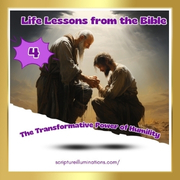 12. Life Lessons from the Bible No. 4: The Transformative Power of Humility
Humility is one of those words that almost everyone agrees is admirable and almost no one fully understands. It tends to get confused with its counterfeits. People mistake it for low self-esteem, for the refusal to acknowledge one’s own abilities, for a kind of perpetual apology for one’s existence. Others mistake it for a strategic posture, a way of appearing modest in order to be thought well of. Neither of those is what Scripture means by humility, and both of those distortions make the real thing harder to find.
The confusion matters because Scripture treats humility as absolutely foundational. Not as one virtue among many, not as a nice quality to cultivate if you happen to be that kind of person, but as the posture from which everything else in the Christian life flows. God opposes the proud and gives grace to the humble: that is not a suggestion, it is a statement about how reality works in relation to God. Which makes getting humility right rather urgent.
This article is the fourth in a series on great life lessons from the Bible. It takes the topic seriously enough to go back to what Scripture actually says: to the Greek and Hebrew behind the English, to the specific passages in their full context, and to the hardest question that humility raises. That question is not how to be more self-effacing. It is this: what does it actually look like to see yourself accurately, before God, and to live from that reality?
 13. Life Lessons from the Bible No. 5: Perseverance – The Steadfast Journey
There is a kind of suffering that surprises you, and a kind that wears you down. The first kind arrives suddenly: a diagnosis, a phone call, a collapse of something you had taken for granted. It knocks you off your feet, and everyone around you can see you have been knocked off your feet. The second kind is quieter and, in many ways, harder. It is the trial that goes on and on. The grief that does not resolve. The prayer that you have prayed a hundred times without obvious answer. The situation that you have tried everything to change and that has not changed. The first kind tests your resilience. The second kind tests whether you actually believe what you say you believe.
Perseverance is the virtue that Scripture calls for in the face of the second kind. It is not the frantic energy of the first response, nor the dramatic gesture of the crisis moment. It is the quiet, costly, day-after-day decision to keep trusting, to keep walking, to keep fixing your eyes on what you cannot yet see. It is, if we are being honest, one of the most difficult things the Christian life asks of any of us.
This article is the fifth in a series on great life lessons from the Bible. It takes perseverance seriously enough to sit with the hard questions: what does it actually mean to “count it all joy” in the middle of suffering? What do we do when the trial does not end and the apparent purpose remains invisible? And how do we persevere without sliding into a kind of grim endurance that has nothing to do with the living faith Scripture describes?
 14. Living Out Your Faith in the Workplace: A Christian’s Guide
Most of us spend more of our waking hours at work than anywhere else. More hours than in church. More hours than with family. More hours than in prayer. That simple fact raises a question that the Christian faith cannot sidestep: what does it mean to follow Jesus in that space? Not merely to avoid behaving badly, not merely to find opportunities for religious conversation, but to be genuinely, distinctively Christian in the full texture of your working life?
This is not a new question. It is as old as the exile of Daniel to Babylon, as old as Joseph in Potiphar’s house, as old as the first believers working as tentmakers and fishermen and tax collectors in the Roman world. What is new is the particular shape our context gives it: workplaces that are more diverse, more surveilled, more competitive, and in many ways more defining of personal identity than those earlier contexts. The question is both ancient and urgent.
This article tries to take the question seriously. Not as a checklist of faith-friendly behaviours, but as a genuine exploration of what Scripture says about work itself, about integrity under pressure, about the texture of Christian witness in everyday professional life, and about what you do when faithfulness has a cost.
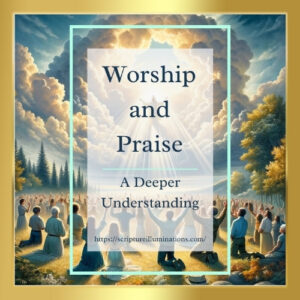 15. Worship and Praise: A Deeper Understanding
Every Christian has had the experience of going through the motions. You are in a church service, the congregation is singing, the words are on the screen, and you are producing the correct sounds at the correct moments, but something essential is absent. The body is present; the heart is somewhere else entirely. You know this is not what worship is supposed to be. What you are less sure of is what worship actually is supposed to be, and how a person gets from one to the other.
This matters more than it might first appear. Worship is not simply one item among many on the Christian life agenda. Scripture consistently presents it as the central orientation of the entire human life, the activity for which we were made, the posture that puts everything else in its proper place. Understanding what worship genuinely is, and what it is not, is one of the most practically urgent questions a Christian can ask.
This article takes that question seriously. It will not offer a shortlist of worship styles or a guide to improving your quiet time. It wants to go deeper: to ask why God desires worship at all, what worship in its fullest form looks like in Scripture, what the difference is between praise and lament and whether both belong to worship, and what Paul means when he tells the Romans that their whole embodied existence can be offered as worship. None of these questions have easy answers, but all of them have honest ones.
Articles List – Page 1 – | Page 2 | Page 3 |