
Article List – Page 2 –
 16. Developing A Deeper Relationship With God
There is a phrase so common in Christian circles that it has almost lost the capacity to surprise: “a personal relationship with God”. You hear it in sermons, read it in devotionals, and encounter it in the conversion stories of Christians across centuries. And yet, if you stop to think about what it actually claims, it is one of the most audacious things a human being can say. A relationship, personal and ongoing, with the Creator and Sustainer of the universe, the one before whom the seraphim cover their faces. The claim is not modest.
Most Christians affirm it without much trouble. Fewer would say with confidence that they experience it. There is often a gap between the language of intimacy and the actual texture of their spiritual life: the prayers that feel as though they travel no further than the ceiling, the Scripture reading that has become a dutiful routine rather than a living encounter, the sense of God as a theological fact rather than a living presence. The question is not whether the relationship is real but how to inhabit it more fully.
This article is an attempt to take that question seriously. It will not offer a five-step programme, because this is not that kind of subject. What it will do is examine what Scripture actually says about what it means to know God, and specifically to address the things that the standard treatment of this topic tends to miss: the foundational question of who initiates this relationship and why that matters entirely; the costly and specific friendship Jesus extends in John 15; the honest realities of prayer and Scripture engagement; and what to do in the seasons when God seems unreachably distant. Real relationship involves all of these dimensions.
 17. Embracing Repentance: A Deeper Journey of Transformation in Christian Faith
Most Christians have a complicated relationship with the word “repentance”. They know it matters. They have heard it preached, and they understand in principle that it is central to the Christian life. And yet, for many believers, the practice of repentance tends to produce something closer to guilt than to freedom, something that leaves them circling their failures rather than moving away from them. They confess, they resolve, they fall again, they confess once more, and the cycle continues without the transformation they were promised.
Some of this is simply the difficulty of change, which is real. But some of it reflects a misunderstanding of what repentance actually is. If repentance is primarily about feeling sufficiently sorry, then it degenerates into a performance of remorse that measures itself by the intensity of the guilt experienced. If it is primarily about making promises to do better, it becomes an increasingly demoralising cycle of failure. If it is understood as the mechanism by which forgiveness is earned, it becomes a burden no one can carry.
Scripture’s account of repentance is more interesting and more liberating than any of these framings. It is a word about direction more than feeling, about movement more than emotion, about who you are returning to rather than merely what you are leaving behind. Understanding this properly makes repentance not something to dread but something to pursue, because it is the path back to the only relationship that can satisfy the deepest longings of a human life.
18. Embracing Divine Protection and Guidance Through Scripture
There are seasons in life when the ground you thought was solid begins to shift. A diagnosis comes back with words you were not prepared to hear. A relationship fractures in ways that seemed impossible. A future you had planned unravels overnight. In moments like these, something primal in us reaches out, searching for something that will hold.
The Christian faith does not offer immunity from these moments. Scripture is honest enough to acknowledge that the righteous walk through valleys, face enemies, and cry out in the dark. What Scripture does offer is something far more durable than a trouble-free life: the assurance that the God who created all things is present with His people, that He is not passive in their suffering, and that no force in existence can ultimately separate them from His love.
This article is an exploration of some of the Bible’s richest passages on divine protection and guidance. These are not simple comfort texts to be glanced at in a crisis and then set aside. They are deep wells that deserve sustained attention. They reveal who God is, what He has committed Himself to, and what it means, practically and spiritually, to live under His care.
 19. Overcoming Doubt and Building a Stronger Faith
If you have ever sat in church, sung the words of a hymn, and felt nothing, you will know the particular loneliness of doubt. Not the clean, philosophical kind of doubt that makes for interesting conversation, but the kind that surfaces at two in the morning when life has not gone the way you expected. The kind where the words you used to believe ring hollow, and you are not sure if the problem is God or you.
A large portion of Christian life seems to be spent pretending this does not happen. Doubt is treated as the enemy of faith, something to be confessed and quickly overcome, the spiritual equivalent of a head cold. The sooner you get back to certainty, the better.
But Scripture tells a more honest story. The Bible is full of people who believed and struggled, who trusted and questioned, who cried out to God in anguish and demanded answers. Faith, as the Bible presents it, is not the absence of doubt. It is something deeper and more durable: a trust that holds even when understanding fails.
This article is an attempt to take doubt seriously, on its own terms, with the full weight of Scripture behind it. Not to explain it away, but to understand what it actually is, why it arises, what the Bible says about it, and how a living faith can be built in the midst of it rather than only after it has been resolved.
 20. Exploring the Depths of Hope in Times of Trial
There are seasons in life when hope feels less like a settled conviction and more like a word you’re no longer sure you believe. The diagnosis arrives. The marriage fractures. The prayer goes unanswered for so long that you start to wonder whether you’re praying into silence. In those moments, the word hope can feel like a cruelty, something people say when they don’t know what else to offer.
But the hope Scripture describes is not that kind of hope. It is not optimism in disguise. It is not a cheerful attitude you can conjure by focusing on the positive. Biblical hope is something far more solid and far more demanding, and far more honest about the reality of suffering. It is worth taking the time to understand what it actually is, because if you mistake it for something thinner, you will lose it the first time life gets truly hard.
This article is for those who want to go deeper than the surface. It is for people who have sat in the dark and found that easy answers did not help, and who want to know what the Bible actually says about hope, not as a platitude, but as a lifeline.
 21. Understanding the fruits of the Spirit and how to cultivate them
As followers of Christ, our ultimate goal is to live a life that is pleasing to God and reflects His character. One of the ways we can achieve this is by cultivating the fruits of the Spirit in our lives. In this article, we will delve deeper into what the fruits of the Spirit are and how we can intentionally cultivate them in our daily lives.
22. The Meaning and Significance of Baptism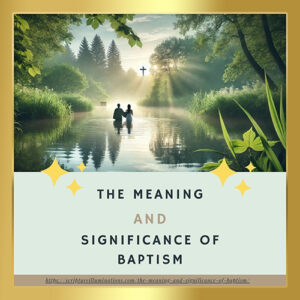
As a Protestant Christian, baptism carries profound spiritual significance. It is much more than just a ceremonial act; it is a public declaration of a deep and personal inward transformation. Baptism symbolizes a believer’s identification with Christ in His death, burial, and resurrection. By examining its biblical foundation and theological implications, we can better understand why baptism is a crucial step in a Christian’s walk of faith and how it reflects the transformative work of the Holy Spirit.
 23. The Impact of Prayer
Prayer is a powerful and transformative practice that Christians have embraced for centuries as a primary means of connecting with God. Through prayer, believers express gratitude, seek forgiveness, ask for healing, and pursue guidance. The Bible attests to prayer’s profound impact on individual lives and the wider community. In this article, we’ll explore the ways prayer influences the believer and provide actionable steps to deepen one’s prayer life.

24. Salvation in Christianity: A Deeper Understanding
Salvation in Christianity is the act of being saved from the consequences of sin through faith in Jesus Christ. It’s a cornerstone of the faith, encompassing both a one-time decision to accept Christ and a lifelong journey of sanctification–becoming more like Him. This article will delve deeper into the concept of salvation, explore relevant biblical teachings, consider additional reflections outside of Scripture, and provide practical steps for readers to apply these principles to their lives.
 25. The Power of Praise and Worship
As Christians, praise and worship play a vital role in our faith journey. They are far more than just singing songs or attending church services; they are powerful expressions of love and gratitude to God for all He has done. In this exploration, we will dive into the power of praise and worship, its significance, and its transformative potential, followed by actionable steps and devotional suggestions to help you incorporate it into your daily life.
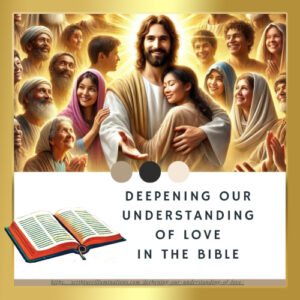 26. Deepening our Understanding of Love in the Bible
Love is one of the most profound and central themes in the Bible. It is woven into the fabric of God’s relationship with humanity and serves as the foundation for Christian living. Love in Scripture is not merely an abstract concept or emotion but a dynamic force that shapes our interactions with God and others. Understanding love in its biblical depth allows us to fully grasp its significance in our faith journey and apply it in our daily lives.
 27. Overcoming fear and anxiety with faith
Fear and anxiety are deeply human experiences, affecting people from all walks of life. Even strong believers are not immune to these feelings. Yet, as Christians, we are not left powerless. Through faith, prayer, the Word of God, and the support of fellow believers, we can overcome fear and anxiety, finding refuge in the unshakable presence of God.
 28. Hope of Salvation for Unsaved Family Members
Like many Christians I have struggled with the issue of beloved family members who do not also believe. I want to pray with trust and faith, but was always blocked because although I know without a doubt that God can do anything and that nothing is beyond Him. I also know that He doesn’t do everything I want. And I had no assurance that God planned on saving my family.
So one day, in a desperate attempt to ascertain if it MIGHT be God’s Will to save my family, I looked up as many Bible verses as possible on the subject, because I know that God’s Word does not lie, it does not have errors and that God has said His Word will not return void. The following verses and their explanations of why they have been chosen are below.
The basic principles are: What does God say to Christians in this situation? Are there any promises we can hold on to? What is God’s heart for the families of His chosen? Do our actions really have any effect on whether our families also come to Christ or not?
 29. Here & Now in Jesus: The Earth-Side Benefits Series – Part 1: Secure in Christ: Identity & Peace
Why start with “security”?
Everyone–whether they sit in a church pew, browse spirituality blogs, or avoid faith talk altogether–asks, Who am I? and Am I safe? The Bible’s answer is surprisingly positive for anyone who trusts Jesus. Before we explore power, purpose, or spiritual gifts in later instalments, we need a rock-solid foundation: the believer’s new identity and the deep peace that flows from it.
30. Here & Now in Jesus: The Earth-Side Benefits Series – Part 2: Spirit-Formed Character: Growing from the Inside Out
1 A Fresh Core: The Fruit the Spirit Bears
Galatians 5:22-23 (NASB)
“But the fruit of the Spirit is love, joy, peace, patience, kindness, goodness, faithfulness, gentleness, self-control; against such things there is no law.”
When Paul lists this nine-flavoured “fruit”, he isn’t handing us a self-improvement checklist. Fruit (singular) pictures one living cluster that ripens naturally whenever Christ’s Spirit has room inside us. In other words, character change is Spirit-grown, not self-manufactured.
Theological snapshot – sanctification: the lifelong process by which the Holy Spirit sets believers apart and shapes them to reflect Jesus’ likeness. It starts the moment we trust Christ and continues until we see Him face-to-face.
Articles List – Page 1 – | Page 2 | Page 3 |