Matthew 1 (NASB 1995)
The Genealogy of Jesus Christ
¹ The record of the genealogy of Jesus the Messiah, the son of David, the son of Abraham. ² Abraham was the father of Isaac, Isaac the father of Jacob, and Jacob the father of Judah and his brothers. ³ Judah was the father of Perez and Zerah by Tamar, Perez was the father of Hezron, and Hezron the father of Ram. ⁴ Ram was the father of Amminadab, Amminadab the father of Nahshon, and Nahshon the father of Salmon. ⁵ Salmon was the father of Boaz by Rahab, Boaz was the father of Obed by Ruth, and Obed the father of Jesse. ⁶ Jesse was the father of David the king.
David was the father of Solomon by Bathsheba who had been the wife of Uriah. ⁷ Solomon was the father of Rehoboam, Rehoboam the father of Abijah, and Abijah the father of Asa. ⁸ Asa was the father of Jehoshaphat, Jehoshaphat the father of Joram, and Joram the father of Uzziah. ⁹ Uzziah was the father of Jotham, Jotham the father of Ahaz, and Ahaz the father of Hezekiah. ¹⁰ Hezekiah was the father of Manasseh, Manasseh the father of Amon, and Amon the father of Josiah. ¹¹ Josiah became the father of Jeconiah and his brothers, at the time of the deportation to Babylon.
¹² After the deportation to Babylon: Jeconiah became the father of Shealtiel, and Shealtiel the father of Zerubbabel. ¹³ Zerubbabel was the father of Abihud, Abihud the father of Eliakim, and Eliakim the father of Azor. ¹⁴ Azor was the father of Zadok, Zadok the father of Achim, and Achim the father of Eliud. ¹⁵ Eliud was the father of Eleazar, Eleazar the father of Matthan, and Matthan the father of Jacob. ¹⁶ Jacob was the father of Joseph the husband of Mary, by whom Jesus was born, who is called the Messiah.
¹⁷ So all the generations from Abraham to David are fourteen generations; from David to the deportation to Babylon, fourteen generations; and from the deportation to Babylon to the Messiah, fourteen generations.
The Birth of Jesus Christ
¹⁸ Now the birth of Jesus Christ was as follows: when His mother Mary had been betrothed to Joseph, before they came together she was found to be with child by the Holy Spirit. ¹⁹ And Joseph her husband, being a righteous man and not wanting to disgrace her, planned to send her away secretly. ²⁰ But when he had considered this, behold, an angel of the Lord appeared to him in a dream, saying, "Joseph, son of David, do not be afraid to take Mary as your wife; for the Child who has been conceived in her is of the Holy Spirit. ²¹ She will bear a Son; and you shall call His name Jesus, for He will save His people from their sins."
²² Now all this took place to fulfill what was spoken by the Lord through the prophet: ²³ "BEHOLD, THE VIRGIN SHALL BE WITH CHILD AND SHALL BEAR A SON, AND THEY SHALL CALL HIS NAME IMMANUEL," which translated means, "GOD WITH US."
²⁴ Joseph awoke from his sleep and did as the angel of the Lord commanded him and took Mary as his wife, ²⁵ but kept her a virgin until she gave birth to a Son; and he called His name Jesus.
Introduction
Matthew begins his Gospel with a genealogy. To many modern readers, that feels like an odd starting place. Why not begin with a dramatic scene, a teaching, a miracle? The answer is that Matthew is writing for a Jewish audience deeply formed by the Hebrew Scriptures, and for them, a genealogy is not background noise. It is the opening argument. It is the evidence table. It is Matthew saying, before a single miracle is described or a parable told: here is the proof.
The proof of what? That Jesus of Nazareth is the Messiah promised to Abraham and the king promised to David. Every line of this opening chapter carries that weight. The genealogy ties Jesus to Israel's covenants. The birth narrative explains how he came. The name he is given declares what he will do. And the ancient prophecy he fulfils places him at the centre of a plan that has been unfolding for centuries.
Matthew 1 is not a gentle warm-up. It is a bold theological claim made in the most Jewish way possible: through lineage, Scripture, and the sovereign purposes of God.
Historical Context
Matthew writes into a world that has been waiting for a very long time. The last canonical prophetic voice, Malachi, had spoken more than four hundred years before the birth of Jesus. That silence was not merely historical; it was felt spiritually. The Jews of the first century lived under Roman occupation, beneath layers of political and religious tension, with a shared memory of what God had once done for his people and a deep, aching hope that he would do it again.
The political situation was grim. Judea was governed by Roman-appointed rulers. Herod the Great, who would die within a few years of Jesus’ birth, had ruled with paranoia and brutality while maintaining a careful performance of Jewish piety for public consumption. His rebuilding of the Jerusalem temple was magnificent by any standard, but it could not disguise the fact that Israel's sovereignty had been surrendered. Rome set the agenda, collected the taxes, and executed those it deemed threats.
Socially, Jewish society was deeply fragmented. The Pharisees pursued holiness through meticulous Torah observance. The Sadducees, concentrated in the temple establishment, held theological and political power while accommodating Roman rule. The Zealots dreamed of violent liberation. The Essenes withdrew to the desert to wait for God's direct intervention. Ordinary Jewish families navigated between these movements, clinging to their faith, observing the Sabbath, and hoping.
Into this world, Matthew makes his claim. His audience knows the Scriptures. They know the covenants. They know that God promised Abraham a people and a land and a blessing to all nations (Genesis 12:1–3), and that God promised David an everlasting kingdom through his descendants (2 Samuel 7:12–16). Matthew's opening chapter is his announcement that both promises have now arrived in a single person.
It is worth noting who Matthew himself was. He was a tax collector, one of the most despised figures in Jewish society, seen as a collaborator with Rome and a traitor to his own people. That a man of his background would write the most deeply Jewish of the four Gospels is itself a testimony to the transforming power of the person he encountered. Matthew does not write as an outsider presenting Jesus to Jews; he writes as a Jew presenting his Messiah to his own people.
Archaeological & Cultural Notes
Understanding Matthew 1 is greatly enriched by stepping into the material world of first-century Jewish life. A number of specific archaeological discoveries and cultural practices shed direct light on what Matthew is doing in this opening chapter.
1. Jewish Genealogies Were Legally Preserved Documents
Ancient genealogies were not casual family stories. They were legal instruments. They established inheritance rights, land claims, tribal identity, priestly eligibility, and covenant status. The Jewish historian Josephus, writing in the late first century, publishes his own genealogy in his autobiography (Life 1.1–3) and describes the careful preservation of priestly genealogical records in temple archives. He notes that priests were required to demonstrate their Levitical lineage before serving.
This is directly relevant to Matthew's purpose. When he traces Jesus' lineage to David and Abraham, he is not offering family lore. He is presenting legal credentials. The claim that Jesus is "the son of David, the son of Abraham" (v. 1) would have been either verifiable or dismissible to his Jewish readers. The fact that it was not dismissed by those who had access to the same records is itself significant.
2. The Givat Hamivtar Tomb Inscription (First Century BCE)
One of the most striking archaeological confirmations of how seriously Jews preserved genealogical identity comes from a tomb discovered in 1970 during construction work in the Givat Hamivtar neighbourhood of northeast Jerusalem. The tomb, dated to the first century BCE, contained an Aramaic inscription on the wall, written in the archaic Palaeo-Hebrew script, which reads in part:
"I am Abba, son of the priest Eleazar, son of Aaron the high priest. I, Abba, the oppressed and the persecuted, who was born in Jerusalem and went into exile in Babylonia, and brought back Mattathiah son of Judah, and buried him in the cave which I acquired by the writ."
The inscription demonstrates several things directly relevant to Matthew 1. First, a private individual in first-century Jerusalem was recording his priestly lineage going back generations, including exile and return, in a burial inscription. Second, the Aaronic priestly line was something people actively maintained and proclaimed as central to their identity. Third, genealogical memory across generations, including the specific trauma of exile, was preserved and considered worth carving in stone.
3. Ossuaries and Family Identity
Nearby excavations in 1968, conducted by archaeologist Vassilios Tzaferis, also uncovered ossuaries (limestone bone boxes used for secondary burial) inscribed with the names and family relationships of the deceased. Names were routinely given in the form "X son of Y," and multiple generations could be recorded. This is precisely the format Matthew uses throughout his genealogy: "Abraham was the father of Isaac, Isaac the father of Jacob."
The ossuary naming pattern confirms that the patrilineal identification Matthew employs was not a literary device; it was the normal vocabulary of Jewish identity in his era. To identify a man by his father's name was to locate him within a web of covenant, family, and legal standing.
4. Betrothal and Marriage in First-Century Judaism
Mary and Joseph were betrothed (Greek: mnesteuo), a state that was legally and socially far weightier than a modern engagement. In Jewish practice of the first century, betrothal was the first formal stage of marriage. The couple was legally bound; the woman was considered the man's wife in all legal respects, and the union could only be dissolved through a formal bill of divorce. The woman remained in her father's home for approximately one year while the man prepared a place for her.
If a betrothed woman was found to be pregnant by another man, this was treated as adultery under Jewish law and could in principle carry severe consequences, including public shaming and potentially worse. This is the legal and social weight behind Joseph's dilemma in verses 18–19. His decision to divorce Mary quietly, rather than expose her to public disgrace, tells us something remarkable about his character: he was willing to bear the social cost of the situation himself rather than destroy her.
5. The Name "Jesus" (Yeshua)
The name Jesus is the Greek rendering of the Hebrew Yeshua, itself a shortened form of Yehoshua (Joshua), meaning "Yahweh saves" or "Yahweh is salvation." This was not an uncommon name in first-century Judaism; several men named Yeshua appear in Josephus' writings. But here it is given as a divine commission: the angel does not merely predict the name but explains it. "He will save His people from their sins" (v. 21). The name is the mission statement.
6. The Four Women in the Genealogy
Matthew's inclusion of four women in a patrilineal genealogy is striking and deliberate. Ancient Jewish genealogies almost never named women. The fact that Matthew names four, all with complex stories and none of them straightforward examples of conventional virtue, is a theological statement, not an oversight.
Tamar (Genesis 38) disguised herself as a prostitute to secure her rights from her father-in-law Judah after he withheld his third son from her. The text calls her more righteous than Judah. Rahab (Joshua 2) was a Canaanite prostitute in Jericho who hid the Israelite spies and confessed faith in the God of Israel. Ruth (Ruth 1–4) was a Moabite widow who, by every ethnic and religious category of her time, was an outsider to the covenant. In Matthew’s Greek, Bathsheba is not even given her own name; she is simply described as "she who had been the wife of Uriah," invoking the sin and its cost without flinching (the NASB adds her name for clarity).
Together these four women tell a story: God's redemptive purposes run through the broken, the scandalous, the outsider, and the wronged. They prepare the reader for a Messiah who will not arrive to reward the morally tidy but to save sinners.
Passage Study
Matthew 1 divides into two parts, each serving a distinct theological function. Working through them reveals a chapter of far greater depth than a surface reading suggests.
Verses 1–17: The Genealogy as Gospel
Most readers, if they are honest, skim genealogies. The long list of unfamiliar names can feel like a waiting room you have to sit through before the real story begins. But Matthew's genealogy is not a waiting room. It is the opening argument. Everything that follows depends on it.
The very first verse makes the claim Matthew intends to prove for the rest of his Gospel: Jesus is "the Messiah, the son of David, the son of Abraham." Three titles in one sentence, each carrying enormous theological weight.
Son of Abraham means Jesus stands in the line of the covenant God made with Abraham in Genesis 12:1–3, the promise that through Abraham's offspring all the nations of the earth would be blessed. This was not a promise to Israel alone. It was a promise with a global reach. Matthew places it first because his Gospel will end with Jesus sending his disciples to all nations (Matthew 28:19). The ending was already written into the beginning.
Son of David places Jesus in the royal covenant God made with David in 2 Samuel 7:12–16, the promise that one of David's descendants would reign on an everlasting throne. Every devout Jew reading Matthew's opening verse would have felt the weight of those two words. They had been waiting for the Son of David for centuries. Matthew is saying: the wait is over.
The structure of the genealogy reinforces the argument. Three groups of fourteen generations are not accidental. As discussed in the Appendix, the Hebrew letters of the name David add to fourteen, so Matthew's three-times-fourteen is a way of saying: David, David, David. Every section of the genealogy is marked with David's name encoded in its structure, driving home the point that Jesus is the promised son of David.
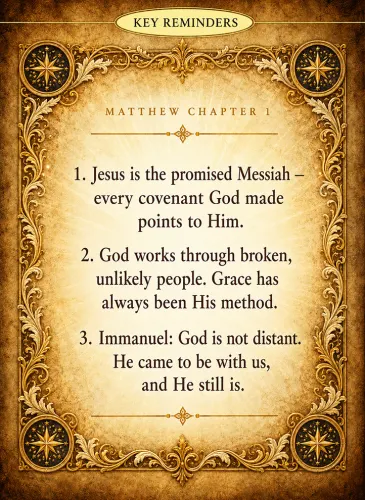
But the most theologically provocative feature of the genealogy is who it includes: four women, none of whom would appear in a conventional Jewish genealogy. Tamar, Rahab, Ruth, Bathsheba. What is Matthew doing? He is dismantling the assumption that God's purposes run only through the respectable, the ethnically pure, and the morally unblemished. The Messiah's family tree is marked by failure, foreignness, and grace. This is not despite God's holiness; it is an expression of his redemptive character.
For the newer believer, this is profoundly reassuring: your history does not disqualify you from being part of what God is doing. For the long-term learner, it raises a deeper question: what does it say about the nature of grace that God chose this genealogy rather than a tidier one? The answer is that grace, by definition, works through what it finds, not through what it requires.
Verses 18–21: Joseph, the Holy Spirit, and the Mission of Jesus
The birth narrative opens not with Mary but with Joseph, and not with joy but with a crisis. Matthew gives us Joseph's interior world: he has discovered that his betrothed is pregnant, he knows he is not the father, and he is trying to work out what to do. He is called dikaios, righteous. But his righteousness is not expressed as severity. He decides not to expose Mary publicly, even though Jewish law would have permitted, perhaps even expected, him to do so. He chooses to absorb the cost quietly. He is willing to be the one who looks like a fool rather than the one who destroys her. That is a remarkable portrait of a man.
The angel's appearance in a dream discloses two things. First, the child has been conceived by the Holy Spirit, a direct creative act of God analogous in some ways to God's creative activity in Genesis 1, where the Spirit of God moved over the waters to bring order and life. Second, the angel gives the child's name and its meaning: "He will save His people from their sins" (v. 21). This is the mission statement of the entire Gospel, given before Jesus has drawn a breath outside the womb.
Notice what it does and does not say. It does not say he will save his people from Roman occupation or political oppression, though his ministry will touch all of those realities. The primary salvation he comes to bring is from sin. Jesus comes not as a political liberator but for something deeper than national restoration: the root problem of every human life in every era, the sin that separates us from God.
Verses 22–25: Fulfilment, Immanuel, and Joseph's Obedience
Matthew introduces a formula in verse 22 that will appear again and again throughout his Gospel: "Now all this took place to fulfill what was spoken by the Lord through the prophet." This is not a throwaway transition. It is a theological claim about the relationship between Israel's Scriptures and the events Matthew is describing.
Matthew is operating with what scholars call a typological understanding of Scripture: God has been planting patterns, pictures, and promises throughout the Old Testament that find their full meaning in Jesus. Isaiah 7:14 was spoken in a specific historical situation, but it contained within it a depth of meaning that only the Incarnation could fully fill.
The name Immanuel, God with us, is theologically the most important statement in the chapter, possibly in the whole of Matthew's Gospel. It is not a title Jesus uses for himself; it is Matthew's interpretive declaration of who Jesus is. The one through whom all things were made (John 1:3) becomes one of the things that were made. The one who fills heaven and earth (Jeremiah 23:24) is contained in a womb, then a manger, then a carpenter's workshop in Galilee. This is the Incarnation, and Matthew announces it in a single phrase before we have seen Jesus do anything at all.
The chapter closes with Joseph waking and obeying. There is no recorded speech, no recorded prayer, no recorded struggle. He simply does what the angel told him to do. He takes Mary as his wife and names the child Jesus, and in that act of naming he formally adopts him, making Jesus his legal son and therefore his legal heir to the Davidic line. Without Joseph's act of naming, Jesus has no formal Davidic identity under Jewish law. Joseph's obedience is not peripheral to the Christmas story; it is structurally essential to it.
Word Studies
Biblos geneseos (v. 1) – "The record of the genealogy"
The Greek phrase biblos geneseos is significant. Biblos means a written scroll or book; geneseos is the Greek word for "genesis" or "origin." The same phrase appears in the Greek translation of the Old Testament (Septuagint) at Genesis 2:4 and Genesis 5:1. Matthew is deliberately echoing the Genesis language of creation and beginning. He is saying: this is a new genesis. What begins here with Jesus is a new creation.
Christos (v. 1) – "Messiah"
The Greek Christos is a direct translation of the Hebrew Mashiach, meaning "anointed one." In the Old Testament, kings, priests, and prophets were all anointed for their roles. The Messiah was the one who would fulfil all three offices. When Matthew calls Jesus "the Messiah" in his opening sentence, he is making the central claim of his entire Gospel.
Dikaios (v. 19) – "Righteous"
Joseph is described as dikaios, righteous or just. In Jewish ethical vocabulary, this was a high commendation. Significantly, Joseph's righteousness is expressed not in severity but in mercy: he did not want to disgrace Mary. His righteousness was not a legal posture but a character shaped by compassion.
Immanuel (v. 23) – "God with us"
The Hebrew name Immanuel (Immanu-El) combines the preposition im (with), the first-person plural suffix nu (us), and El (God). It is not a theological concept or a poetic metaphor. It is a declaration about location: God is with us, here, in this place, in this person. Matthew's use of it at the end of the chapter captures everything the genealogy and birth narrative have been working toward.
Addressing Hard Questions
Matthew 1 raises several questions that readers genuinely struggle with, and which have been used by sceptics to challenge the credibility of the New Testament. These deserve direct, honest engagement.
Question 1: Why Does Matthew's Genealogy Differ from Luke's?
This is one of the most common questions raised about the Gospels, and when it is left unanswered it can become a stumbling block. Matthew gives Joseph's father as Jacob (Matthew 1:16); Luke gives Joseph's father as Heli (Luke 3:23). Between David and Jesus, the two genealogies share almost no names in common. So what is happening?
The most widely held view among conservative scholars is that Matthew records Joseph's legal lineage and Luke records Mary's biological lineage. Under this reading, Luke names Jesus' grandfather on his mother's side as Heli (Mary's father), with Joseph named as Heli's son-in-law in accordance with Jewish genealogical convention, which did not normally include women. This would explain why Luke, who is more focused on Mary in his birth narrative, preserves her line, while Matthew, who focuses on Joseph, preserves his.
A second explanation, argued by the church historian Eusebius drawing on Julius Africanus, invokes the Jewish practice of levirate marriage. If Heli and Jacob were half-brothers and Heli died without a son, Jacob would have married Heli's widow, making Joseph the biological son of Jacob but the legal son of Heli. Either explanation accounts for the difference without requiring an error in the text.
What is most important is that both genealogies agree on the central point: Jesus is a descendant of David. Both lines run through David; Matthew through Solomon, Luke through Nathan. The theological claim is identical in both texts, and it is the claim that matters.
Question 2: Does the "Curse of Jeconiah" Disqualify Jesus?
In Jeremiah 22:30, God pronounces judgment on King Jeconiah: "Record this man as if childless, a man who will not prosper in his lifetime, for none of his offspring will prosper, none will sit on the throne of David or rule any more in Judah." Since Jeconiah appears in Matthew's genealogy (v. 11–12), the argument runs: if no descendant of Jeconiah can sit on David's throne, Jesus is disqualified.
This objection dissolves when Jeremiah 22 is read carefully in context. First, the Hebrew word for offspring frequently refers to immediate children rather than all future generations in prophetic judgment passages. Second, the text qualifies itself: "a man who will not prosper in his lifetime." The judgment is about Jeconiah's own era. Third, the monarchy ended for every branch of the Davidic family after 586 BCE; no Davidic descendant of any lineage was reigning. Fourth, Jewish tradition itself never understood Jeconiah's line as permanently disqualified; the Talmud (Sanhedrin 37b–38a) and the midrash (Leviticus Rabbah 19:6) affirm that God reversed the curse on Jeconiah because he repented in exile, and his grandson Zerubbabel was honoured in Haggai 2:23 as a Messianic figure.
Matthew himself would have known Jeremiah 22 perfectly well, and no early Jewish critic of Christianity appears to have raised this as an objection. The real weight of the Davidic covenant rests not on any single generation's unbroken legal record but on God's own faithfulness to his promise.
Question 3: Does Isaiah 7:14 Actually Predict a Virgin Birth?
Critics point out that the Hebrew word in Isaiah is almah, which they argue means simply "young woman" rather than "virgin." The honest answer is that almah does refer to a young woman of marriageable age, and the word does not make virginity its explicit focus. However, the pre-Christian Jewish translators of the Old Testament into Greek, producing what is known as the Septuagint, translated almah in Isaiah 7:14 with the Greek word parthenos, which specifically and unambiguously means "virgin." This is not a Christian translation; it predates Jesus by more than a century. Jewish scholars, with no theological interest in predicting a virgin birth, read almah in Isaiah 7:14 as parthenos. Matthew quotes this Greek text.
Furthermore, Matthew is not building the virgin birth on the Isaiah text alone. Luke's Gospel (Luke 1:26–38) describes the annunciation to Mary in detail, and the virgin birth is attested there independently of any Isaiah quotation. Matthew cites Isaiah 7:14 to show that Jesus' birth fulfils a pattern in Scripture. The doctrine of the virgin birth rests on the testimony of Luke, on the angelic declaration in Matthew, and on the consistent teaching of the church from the beginning.
Reflection
Matthew 1 teaches us that God's faithfulness does not require human tidiness. The genealogy is full of people who failed, hurt others, were hurt, made devastating choices, or were simply caught in the crossfire of other people's sin. Tamar was wronged by Judah. Rahab was a Canaanite and a prostitute. Ruth was a Moabite widow with no standing in Israel. Bathsheba was taken by a king who abused his power. David himself was an adulterer and, by the end of that terrible episode, complicit in murder.
God threads his purposes through every one of them. This is not because sin does not matter to him; the consequences in each story make clear that it does. It is because his redemptive purposes cannot be frustrated by human failure. He does not choose perfect vessels. He sanctifies the broken ones.
Joseph's response to the angel's message is the devotional heart of this chapter. He asks no questions. He raises no objections. He demands no further explanation. He simply wakes up and does what God has told him to do. For a man in his position, this would have required everything. His reputation would have been compromised. His neighbours would have done the maths. His obedience cost him socially, and through it God accomplishes something irreplaceable: the legal establishment of Jesus as a son of David.
That should say something to each of us about the value God places on ordinary, costly, unremarked faithfulness.
Devotional Thought
There are seasons in life when God's plan arrives without explanation. Joseph had no theological framework for what the angel told him. He had no precedent in Jewish tradition for a virgin conceiving by the Holy Spirit. He had a message from God and a choice to make in the dark.
Obedience in those moments is not the absence of fear or confusion. It is choosing to act on what God has said rather than on what the situation appears to demand. Joseph must have felt the weight of what people would think, what the law technically allowed, what common sense suggested. He set all of that aside.
The name Immanuel is the promise that makes such obedience possible. God is not directing our lives from a distance, issuing instructions and leaving us to manage the fallout alone. He is with us. The entire point of the Incarnation, which Matthew 1 announces before we have seen a single miracle or heard a single teaching, is that God has come personally into human experience.
You may be carrying something right now that feels disproportionate to your resources. A situation that arrived without warning, a call that costs more than you expected, a season of waiting that has gone on longer than you can easily bear. Matthew 1 speaks directly to that place. The God who was faithful across fourteen generations, who worked through broken people and foreign women and compromised kings, who brought his Son into the world through a carpenter's trust, is still working.
Jesus is still Immanuel. God is still with us.
Action Steps
- Read the four women's stories this week. Take time to read Genesis 38 (Tamar), Joshua 2 (Rahab), Ruth 1–4 (Ruth), and 2 Samuel 11–12 (David and Bathsheba). Sit with how God is present in each story and what each reveals about his character.
- Identify one area of your life where you have been waiting for God to explain himself before you obey. Bring that specific thing to God in prayer. Ask him for the faith to act on what you already know is right.
- Meditate on the name Immanuel. Write it somewhere you will see it this week. Each time you see it, pause and let the truth land: God is with you, not watching from a distance, but here, present, in whatever you are facing today.
- If you have questions about the Bible that have gone unanswered and have been quietly undermining your faith, do not leave them there. Bring them to God, to a trusted pastor or teacher, or to serious study. Honest questions deserve honest engagement.
Further Study
- Isaiah 7:14 – The original Immanuel prophecy in its historical context.
- 2 Samuel 7:12–16 – The Davidic covenant: God's promise of an eternal throne.
- Genesis 12:1–3 – The Abrahamic covenant: the promise of blessing to all nations.
- Jeremiah 22:24–30 – The oracle against Jeconiah; read alongside Jeremiah 23:5–6.
- Haggai 2:20–23 – Zerubbabel (Jeconiah's grandson) as a Messianic type.
- Luke 1:26–38; 3:23–38 – Luke's annunciation and genealogy, for comparison with Matthew.
- Ruth 4:18–22 – The genealogy leading to David, foreshadowing Matthew 1.
Appendix: Understanding Matthew's Three Sets of Fourteen Generations
Matthew's summary in verse 17 states three sets of fourteen generations: Abraham to David, David to the deportation, and the deportation to the Messiah. When readers count the names straight through and compare with Old Testament records, the numbers appear to be off. This has been used as an argument that Matthew is either careless or deliberately manipulating the data. Both suggestions misunderstand how ancient Jewish genealogies worked.
Ancient genealogies were not exhaustive lists of every biological ancestor. They were structured summaries shaped for memorisation, theological emphasis, and legal purpose. Gaps, selective omissions, and deliberate symmetry were standard features. This is confirmed by comparing Matthew's genealogy with the Old Testament records: Matthew omits three kings (Ahaziah, Joash, and Amaziah) who appear in 1 Chronicles 3:11–12 between Joram and Uzziah. This is intentional selection to achieve the three-times-fourteen pattern, not an error.
The three sets also contain hinge names: David ends Era 1 and begins Era 2; Jeconiah ends Era 2 and begins Era 3. When each set is read as its own unit with the hinge name counted in both, the structure of fourteen works exactly as Matthew describes.
Why fourteen? The Hebrew letters of the name David (dalet-waw-dalet) have numerical values of 4, 6, and 4, totalling fourteen. This is gematria, a well-established Jewish literary and mnemonic technique. Matthew's "fourteen" is not arbitrary; it encodes "David" into the very structure of the genealogy. This is not a contradiction or a manipulation. It is a first-century Jewish literary technique that Matthew's original audience would have recognised immediately.
Prayer-Journal Devotional
For personal reflection and journalling
Lord,
As I sit with the opening chapter of Matthew's Gospel, I am struck by how much you were doing before a word was spoken, before an angel appeared, before a single miracle was performed. Fourteen generations. Fourteen more. Fourteen more again. You were working, faithfully, through people who had no idea they were part of a story this large.
I think about Joseph. He did not ask you for a sign, did not negotiate, did not demand clarity before he obeyed. He simply woke up and did what you told him to do. That kind of trust is hard for me. I often want the whole picture before I take a step. Help me, Father, to trust you with the parts of my story I cannot yet see.
Thank you for the women in this genealogy. Thank you that Tamar's story is not tidied up. That Rahab's past is not erased. That Ruth's foreignness is not whitewashed. That Bathsheba's grief is not forgotten. You do not require my life to be presentable before you can use it. You work through the real thing.
And thank you for this name: Immanuel. God with us. Not God observing from a safe distance. Not God managing outcomes from above. God with us, in the mess, in the uncertainty, in the seasons that make no sense yet. That is who you are. That changes everything.
Speak, Lord; your servant is listening.
Pause & Consider
Where do you see God's faithfulness woven through the seasons of your own life, including the ones that felt abandoned at the time?
Reframe Your Focus
Is there a situation you have been reading through the lens of your circumstances rather than through the lens of God's character and promises?
Be Still with God
What aspect of Joseph's obedience speaks most directly to something you are facing right now?
Let Truth Take Root
How does the truth that Jesus is Immanuel, God with us, reshape the way you are holding whatever is heaviest for you today?
Step Forward in Faith
What is one specific step of obedience or trust that you sense God inviting you to take in response to Matthew 1?
Suggested Prayer
Lord Jesus, thank you that you are present in every chapter of my story, both the parts that make sense to me and the parts that still feel unresolved. Help me to trust that, just as you guided generations toward your coming, you are also guiding my life toward your good purposes. Strengthen my faith, deepen my obedience, and let the truth of Immanuel, God with us, take root deeply in my heart today. Amen.
Scripture quotations taken from the New American Standard Bible® (NASB), Copyright © 1960, 1971, 1977, 1995 by The Lockman Foundation. Used by permission. All rights reserved. lockman.org